Imagine you have a rival. Let’s call them “Brand X.” While you’re sleeping, Brand X just landed a high-authority backlink from a top-tier industry publication. In the old days—way back in 2024—you wouldn’t have noticed until your monthly “backlink audit.” You’d open a tool to analyze your link building campaigns, export a messy CSV, and realize you were four weeks too late to the party.
In 2026, that slow-motion approach is a recipe for irrelevance. SEO has evolved into a high-frequency, real-time tactical battle. You don’t need another subscription to a dashboard; you need a 24/7 Digital Spy. You need an AI agent that lives in your server, watches your competitors like a hawk, and does the heavy lifting before you even finish your morning coffee.
The Shift from Static Audits to the 24/7 Digital Spy
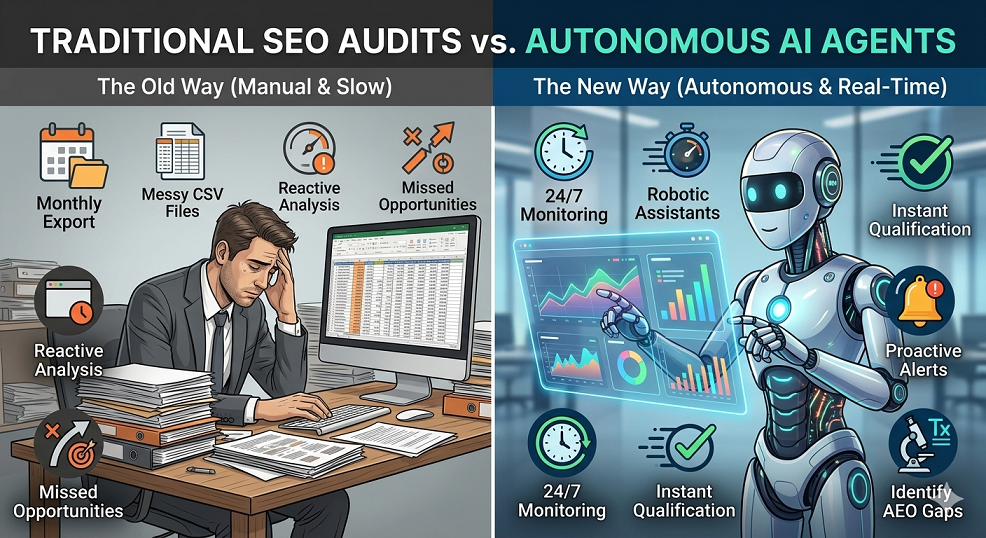
The traditional way of doing SEO feels like trying to win a Formula 1 race while checking the map every thirty minutes. It’s too slow. An AI agent transforms this process from a chore into an autonomous system. We aren’t just talking about “automation”—which is just a fancy word for a scheduled task. We are talking about Agentic Workflows.
Think of an agent as a digital employee. It doesn’t just fetch data; it reasons with it. It looks at a new link and decides if it’s worth your time. It’s the difference between a motion-sensor light and a security guard who can tell the difference between a stray cat and a burglar.
Why Manual Backlink Analysis is Dying in 2026
The Velocity Problem: SEO as a Real-Time Battle
Google’s algorithms and AI-powered search engines now update their understanding of the web in near real-time. If a competitor gains ten high-authority links in a week, they might leapfrog you in the rankings before you’ve even logged into your SEO tool. Waiting 30 days to analyze your “backlink gap” is like reading yesterday’s newspaper to predict today’s stock market.
Data Fatigue: From CSV Files to Meaningless Noise
If you’ve ever stared at a spreadsheet with 5,000 rows of “New Backlinks,” you know the pain. 90% of those links are usually scrapers, “best-of” lists you can’t get into, or low-tier directories. Human brains weren’t meant to filter that much noise daily. We get tired; AI agents don’t.
Enter the AI Agent: Your New Autonomous Digital Analyst
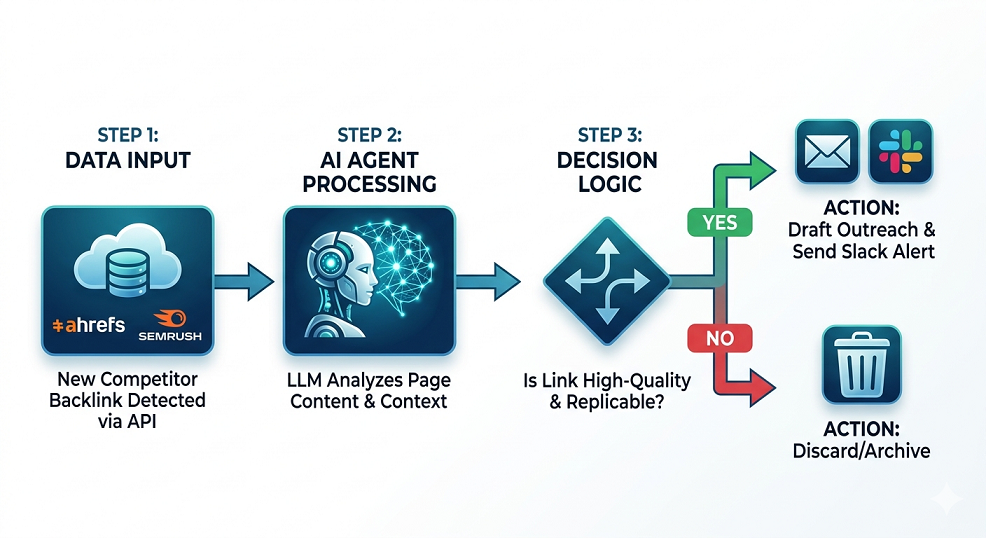
An AI agent is essentially a script or a platform (like n8n, Zapier Central, or a custom Python agent) that uses a Large Language Model (LLM) like GPT-4o or Claude 3.5 Sonnet to perform tasks.
What Makes an Agent “Agentic”?
A simple automation says: “If A happens, do B.” An agent says: “If A happens, evaluate it against my goals, determine if it’s high-quality, and then choose whether to do B, C, or ignore it entirely.”
Phase 1: Building the “Qualification” Filter
This is the “secret sauce.” Most people fail at automation because they automate the collection but not the selection.
Programming the Logic: Distinguishing Junk from Gold
You can program your agent to look at a new backlink and perform a “sniff test.” Using an LLM, the agent visits the linking page and asks:
- “Does this page have actual traffic?”
- “Is the content relevant to our niche?”
- “Is the link placed within the editorial body, or is it a footer spam?”
Replicable Guest Posts vs. Lucky Brand Mentions
Your agent can be taught to categorize links. If the competitor got a link because their CEO was interviewed (a “Lucky Mention”), the agent flags it as low-priority for replication. But if it identifies a guest post or a “top tools” listicle (a “Replicable Link”), it moves to the next stage of the funnel.
Automating the “Can I Win This?” Decision
The agent compares the linking site’s “About Us” or “Write for Us” page. It calculates the probability of success based on your own site’s authority. If the gap is too wide, it silently discards the link. If it’s a match, it moves to your “high-intent” list. You go from 1,000 “junk” links to 10 “gold” opportunities automatically.
Phase 2: Setting Up Real-Time “Link Intersect” Triggers
A “Link Intersect” is when multiple competitors get a link from the same site. It’s the ultimate signal that a site is an “Industry Hub.”
The Logic of “Trending Industry Hubs”
Imagine your agent is watching five competitors. Suddenly, three of them get a link from a new tech blog within 48 hours. That isn’t a coincidence; it’s a trend. A human might miss this pattern across five different tabs, but an agent sees the “intersect” instantly.
Connecting the Pipes: From Webhooks to Slack Alerts
Instead of you hunting for data, the data finds you. You can set up your agent to push a message to a dedicated Slack channel: “🚨 ALERT: 3 Competitors just landed links on TechRadar.com. This is a high-priority hub. Click here for the drafted outreach.”
Phase 3: Measuring the “AI Visibility” Metric (AEO Gap)
This is the most “2026” part of this strategy. We are moving into the era of Answer Engine Optimization (AEO).
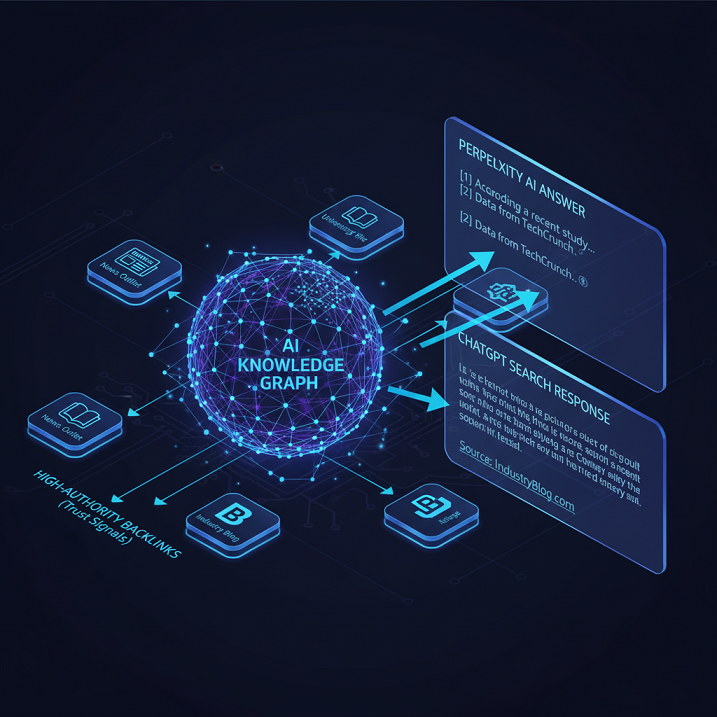
The New Frontier: Perplexity AI and ChatGPT Search Citations
It’s no longer enough to rank #1 on Google. You want to be the cited source when someone asks Perplexity AI, “What is the best SEO agent tool?”
Identifying the AEO Backlink Gap
Your agent can be programmed to check if your competitors’ new links are actually being used as “Knowledge Sources” by AI engines. If Brand X’s new link on a major site causes them to start appearing in ChatGPT Search citations, that link is worth 10x more than a standard backlink. Your agent identifies this “AEO Gap” and prioritizes those specific domains for your own outreach.
The Tech Stack: Tools to Build Your Agent Today
You don’t need a degree in Computer Science to build this.
- Data Source: Ahrefs or Semrush API (to feed the agent new link data).
- The Brain: OpenAI (GPT-4o) or Anthropic (Claude) API.
- The Nervous System: n8n.io (the best for complex logic) or Zapier Central.
- The Output: Slack, Google Sheets, or your CRM (like HubSpot).
The Agentic Workflow: A Step-by-Step Blueprint
- Trigger: A competitor gains a new backlink (via API).
- Crawl: The agent visits the URL of that backlink.
- Analyze: The LLM reads the page content and determines the “Link Type” (Guest post, PR, Resource page).
- Score: The agent assigns a score from 1-10 based on relevance and AEO potential.
- Draft: If the score is >8, the agent finds the editor’s email and drafts a personalized outreach email based on the “pitch angle” it identified on the page.
- Notify: You receive a notification with the link, the score, and the draft.
Conclusion
In the modern SEO landscape, speed isn’t just an advantage; it’s a requirement. By deploying an AI agent as your “24/7 Digital Spy,” you stop reacting to the past and start dominating the present. You move from being a data collector to a strategic commander. The goal isn’t to work harder; it’s to build a system that works while you’re busy doing what humans do best—thinking creatively.
Are you ready to stop auditing and start outmaneuvering?
FAQs
1. Do I need to know how to code to build an AI SEO agent?
Not necessarily. Tools like n8n and Zapier Central allow you to build “No-Code” agents using visual builders. However, understanding basic logic (If/Then statements) is very helpful.
2. Is this “Black Hat” SEO?
No. This is purely competitive intelligence and workflow automation. You are simply using AI to analyze publicly available data and streamline your outreach—all “White Hat” practices. Remember to always follow Google’s SEO link best practices
3. Won’t these agents be expensive to run?
While API calls to models like GPT-4o cost money, the cost is minimal compared to the hours of human labor saved. Filtering for “high-intent” links usually costs pennies per day.
4. Can an AI agent really write a good outreach email?
If you provide a good “Base Prompt” and specific context about your brand, an AI agent can write a draft that is 90% ready. You should always have a “Human-in-the-Loop” to give it the final polish.
5. What is the “AEO Backlink Gap” exactly?
It is the difference between where your competitors are being cited by AI search engines (like Perplexity) and where you are missing. It focuses on the specific links that drive AI visibility rather than just traditional Google rankings.