
Let’s be honest: the “Ten Blue Links” era of Google is feeling a bit like a dusty library these days. You know the drill—you type a query, click three different websites, dodge five pop-ups, and finally find your answer. But today? Users are just asking ChatGPT, Perplexity, or Gemini.
If you want to know how to rank in AI search, you have to stop thinking like a keyword stuffer and start thinking like an authority. The game has changed from “matching keywords” to “providing the most authoritative answer.”
The New Era of Search: Moving Beyond the Search Bar
The search bar is evolving into a conversation. When someone asks an AI a question, the AI doesn’t just show them a list; it synthesizes an answer. If your website isn’t the one being summarized, you basically don’t exist in that conversation.

Why “Traditional” SEO isn’t Enough Anymore
Old-school SEO was about convincing an algorithm that your page was relevant. New-school ranking—Generative Engine Optimization (GEO)—is about convincing an AI that your page is the most reliable source of truth.
What Does it Actually Mean to “Rank” in AI?
Ranking in AI search doesn’t mean being #1 on a list. it means being the cited source. When an AI says, “According to [Your Website], the best way to…” you have won. That citation is the new “Position Zero.”
The Mechanic of the Machine: How AI Engines Choose Winners

To crack the code on how to rank in AI search, we need to look under the hood. AI engines like Perplexity or Search Generative Experience (SGE) use something called Retrieval-Augmented Generation (RAG).
The Librarian vs. The Matchmaker
Traditional Google was a matchmaker—it introduced you to a website. AI is a librarian. It reads your content, extracts the facts, and presents them to the user. To rank, your content needs to be “scannable” by a machine but “trustworthy” for a human.
Why Retrieval-Augmented Generation (RAG) Changes Everything
RAG means the AI “retrieves” live data from the web before “generating” an answer. If your content is structured logically, the AI can retrieve it instantly. If it’s buried under layers of creative prose, the AI will skip right over you.
Step 1: Focus on Information Density Over Word Count
Forget the 2,000-word blog post requirement. AI search engines don’t care about length; they care about density.
Killing the “Fluff” to Please the AI Parser
If you want to rank in AI search, you need to cut the “In today’s fast-paced world…” introductions. Get straight to the point. The higher the ratio of “useful facts” to “filler words,” the more likely an AI is to use your site as a reference.
Step 2: Mastering the “Cite-Ability” Factor
AI models are programmed to be helpful, but they are also programmed to be “safe.” They prioritize content that is easy to cite.
Using Declarative “Power Sentences”
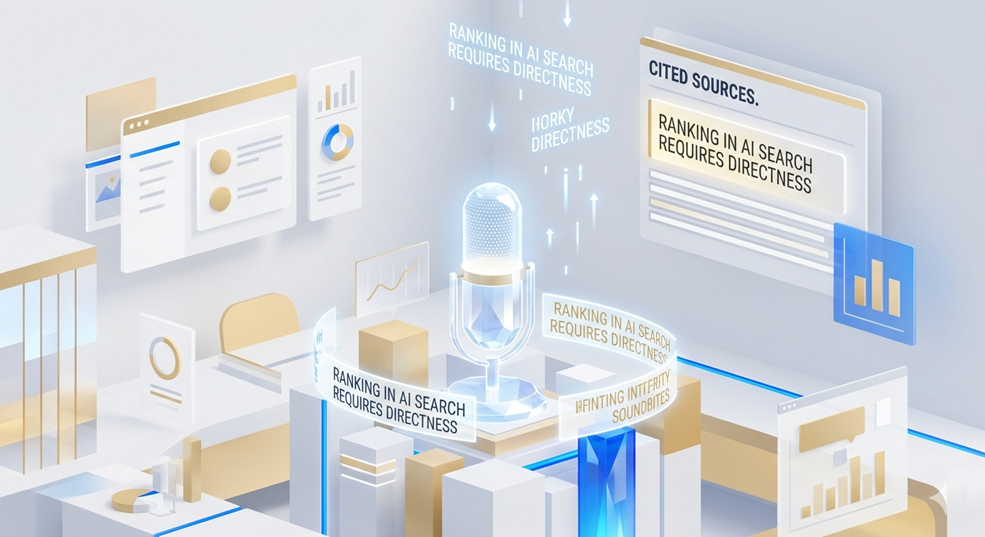
A “Power Sentence” is a short, clear statement that answers a question directly. Instead of saying “One might consider the possibility of ranking,” say “To rank in AI search, you must prioritize structured data.” These are the “soundbites” that AI bots love to copy and paste into their answers.
Step 3: Technical Optimization for AI Bots
If your text is for the user, your backend is for the bot. To rank in AI search, you need to speak the machine’s language.
Schema Markup: Giving the AI a Map
Think of Schema Markup (JSON-LD) as the API for your website. It tells the AI: “This is a price,” “This is a step-by-step guide,” or “This is an expert opinion.” By using advanced Schema, you remove the guesswork for the AI, making it a “trusted” source.
Step 4: Leveraging Unique Data and Statistics
Why would an AI cite you if you’re just saying what Wikipedia already says? To rank in AI search, you need to provide original value.
Why Original Research is Your Secret Weapon
AI engines are hungry for “new” training data. If you publish an original case study, a unique set of statistics, or a proprietary survey, you become an “Original Source.” AI engines will flock to your data because it’s something they haven’t seen 1,000 times before.
Step 5: Building Authority Through “Topic Clusters”
You can’t just write one lucky article and expect to rank in AI search forever. You need to prove you are an authority in your niche.
Becoming the Go-To Source for Your Niche
By creating “topic clusters”—a series of interlinked articles that cover every aspect of a subject—you create a “knowledge graph” for the AI. When the AI sees that you have 50 high-quality articles on one specific topic, it recognizes you as the “Subject Matter Expert.”
Three Essential Pillars to Rank in AI Search Fast
If you want a “cheat sheet” for your next piece of content, focus on these three things:
Pillar 1: Directness (The 5-Second Rule)
Can an AI find the answer to the user’s question in the first 100 words of your article? If not, you’re losing. Put the answer at the top.
Pillar 2: Quotability (Writing in Soundbites)
Use bullet points, numbered lists, and bolded “conclusion” sentences. These are “low-hanging fruit” for AI models looking for a quick summary.
Pillar 3: External Proof (Reddit, Wiki, and Citations)
AI engines look at the “social web” to see if humans trust you. If your brand is mentioned on Reddit, Quora, or industry-specific forums, it acts as a massive “green flag” for the AI algorithm.
The Human Edge: Why AI Still Needs Your Perspective

Here is the irony: the best way to rank in AI search is to be uniquely human. AI can summarize facts, but it can’t provide “lived experience.” Share your personal failures, your unique business insights, and your “hot takes.” That unique perspective is something the AI can’t generate—it can only report on it.
Conclusion: Your Roadmap to AI Dominance
Knowing how to rank in AI search is about shifting your mindset from “gaming the system” to “becoming the system.” By focusing on high information density, clear technical structures, and undeniable niche authority, you aren’t just surviving the AI revolution—you’re leading it.
The future of search belongs to those who provide the clearest, most authoritative answers. Are you ready to be the source the AI quotes?
FAQs
1. How long does it take to rank in AI search results?
Unlike traditional SEO, which can take months, AI search engines that use live web crawling (like Perplexity) can pick up and cite your content within days of publication if it is highly authoritative.
2. Does keyword density still matter?
Keywords still help the AI understand the topic, but “density” is dead. Focus on “topical relevance” and “semantic richness” instead of repeating the same phrase over and over.
3. Will AI search kill my website traffic?
It might reduce “informational” traffic (people looking for quick facts), but it increases “high-intent” traffic. If someone clicks your link from an AI answer, they are much more likely to convert.
4. What is the most important technical factor for AI ranking?
Properly implemented Schema Markup (JSON-LD) is arguably the most important technical factor, as it provides a structured “cheat sheet” for the AI to understand your content.
5. Should I stop building backlinks?
No! Backlinks are still a primary signal of “trust.” If other high-authority sites link to you, the AI assumes you are a safe and reliable source to recommend to its users.