

In the fast-paced world of digital marketing, we’ve hit a fascinating crossroads. It’s 2026, and the “search bar” as we once knew it has evolved into something much more conversational. You’re likely using Perplexity AI—and why wouldn’t you? It’s the gold standard for factual, sourced research. But here’s the cold, hard truth: being factually correct is no longer the “flex” it used to be. If everyone has access to the same high-speed research bots, how do you stand out? The answer lies in the “Perplexity AI Humanizer” approach—not as a tool to trick detectors, but as a strategy to inject soul into your data.
The Post-Search Era: Balancing Efficiency with Intuition
We are officially living in the post-search era. The days of mindless scrolling through blue links are fading, replaced by AI-driven summaries. In this landscape, the winner isn’t the one who provides the most facts; it’s the one who provides the most meaningful facts. While Perplexity can tell you the “what,” it often struggles with the “so what?”
From SEO to GEO: The Shift to Generative Engine Optimization
Traditional SEO (Search Engine Optimization) is being joined by its more sophisticated cousin: GEO (Generative Engine Optimization). GEO isn’t about stuffing keywords into a paragraph; it’s about making your content so authoritative and unique that an AI engine chooses to cite you as its primary source. To do this, you need to balance Perplexity’s raw efficiency with the kind of human intuition that an algorithm simply can’t replicate.
The Content Paradox: Why Perplexity is a Starting Line, Not a Finish Line
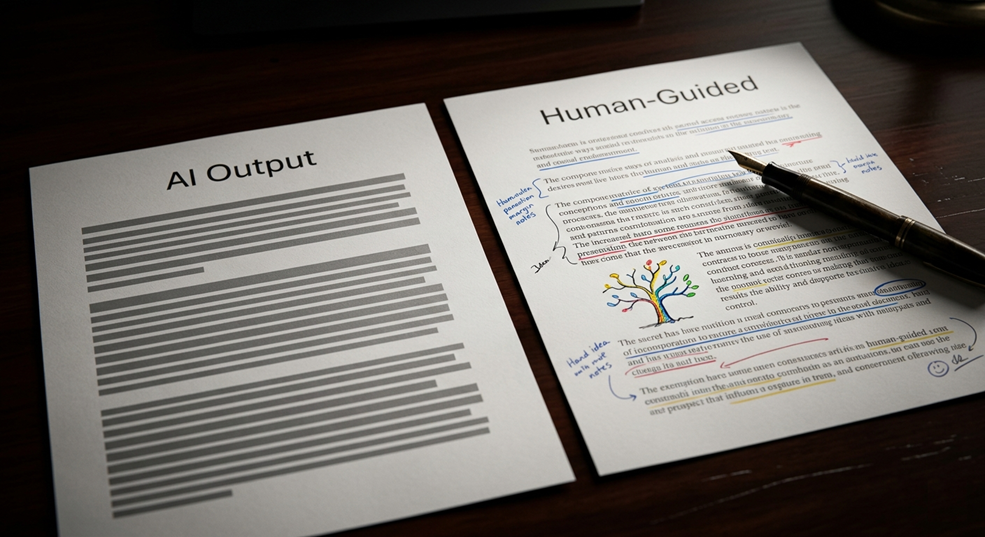
Perplexity is an incredible tool. It’s like having a world-class librarian at your fingertips 24/7. However, this creates a paradox: the more we rely on it, the more “gray” our content becomes. AI-generated text is often structurally perfect but emotionally vacant. It lacks the “narrative soul” that converts a casual reader into a loyal brand advocate.
The Accuracy Trap: Why “Correct” Isn’t Always “Compelling”
Think of AI content as a textbook. Textbooks are accurate, but do people read them for fun? Rarely. If your blog post reads like a manual, your dwell time will plummet. In 2026, ranking requires resonance. You need to take the factual skeleton provided by Perplexity and wrap it in the muscle and skin of human storytelling.
Why Humanize? Moving Beyond the Fear of AI Detectors
Let’s be real—most “AI humanizer” tools are just fancy synonyms-swappers designed to bypass detection software. But here’s a secret: Google and other search engines don’t necessarily hate AI content; they hate low-value content.
Prioritizing User Experience (UX) Over Algorithm Paranoia
Stop worrying about whether a detector gives you a “90% Human” score. Instead, ask: “Will my reader find this useful?” Humanizing your content is about improving User Experience (UX). It’s about making complex data digestible, relatable, and—dare I say—fun. When you write for the human first, the algorithms usually follow suit.
The New Workflow: Perplexity as Your Expert Research Assistant
The most successful digital writers in 2026 treat Perplexity as an assistant, not the author. This workflow allows you to scale your output without sacrificing the “Search-First Authenticity” your audience craves.
Streamlining the Ideation Phase
Use Perplexity to find gaps in current search results. Ask it: “What are people not saying about [Topic]?” This gives you a unique angle that hasn’t been beaten to death by the rest of the internet.
Sourcing Real-Time Data and Citations
One of Perplexity’s strengths is its ability to browse the live web. Use it to pull the latest stats and citations, which adds immediate “Trustworthiness” to your piece. But don’t just list them—explain why they matter to your specific reader.
The Manual Humanizer’s Checklist: Infusing Burstiness and Perplexity
In the world of linguistics, “Perplexity” measures the complexity of text, while “Burstiness” refers to the variation in sentence length. AI tends to be very “middle-of-the-road” in both. Humans, however, are erratic. We write short sentences. Then, we might follow them up with a long, flowing, descriptive sentence that paints a vivid picture before hitting the reader with another punchy line.
Varying Sentence Structure to Mimic Human Thought
To humanize your Perplexity drafts, go through and break up the rhythm. If you see three sentences in a row that are roughly the same length, change them. Use fragments for emphasis. Use semicolons to connect deep thoughts. Keep the reader on their toes.
Vocabulary Diversity: Avoiding the “AI Standard” Lexicon
AI has a “favorite” set of words—words like “delve,” “comprehensive,” and “testament.” If you see these popping up, swap them out for more conversational alternatives. Instead of “delving into the details,” why not “taking a peek under the hood”?
Strategic Editing: Infusing the “E” in E-E-A-T

Google’s E-E-A-T (Experience, Expertise, Authoritativeness, Trustworthiness) guidelines are more relevant than ever. The first “E”—Experience—is the one AI can never fake.
Adding First-Hand Experience and Anecdotes
Did you try a strategy that failed? Tell that story. Did a client ask a weird question that sparked an insight? Include it. These “human-only” moments are what tell a search engine that a real person is behind the keyboard.
Establishing Authority Through Contrarian Perspectives
AI is trained on consensus. It likes to play it safe. To rank in 2026, you often need to be bold. If you disagree with a common industry “best practice,” explain why. Being a bit of a maverick can actually help your GEO scores because you’re providing “Information Gain.”
Answer Engine Optimization (AEO): Becoming the Cited Source
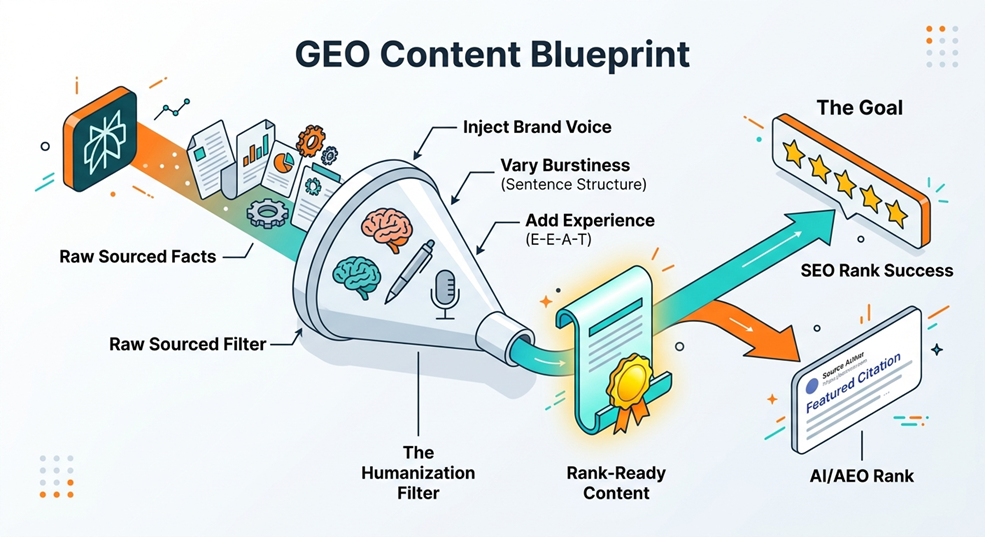
If you want Perplexity or SearchGPT to cite your blog, you have to make their job easy. This is where Answer Engine Optimization (AEO) comes into play.
The 100-Word Rule for Instant Clarity
In the first 100 words of your section, answer the primary question directly. AI bots are impatient; if they can’t find the answer quickly, they’ll move on to a site that provides it upfront.
Formatting for Extraction: Tables, Lists, and “Chunkable” Content
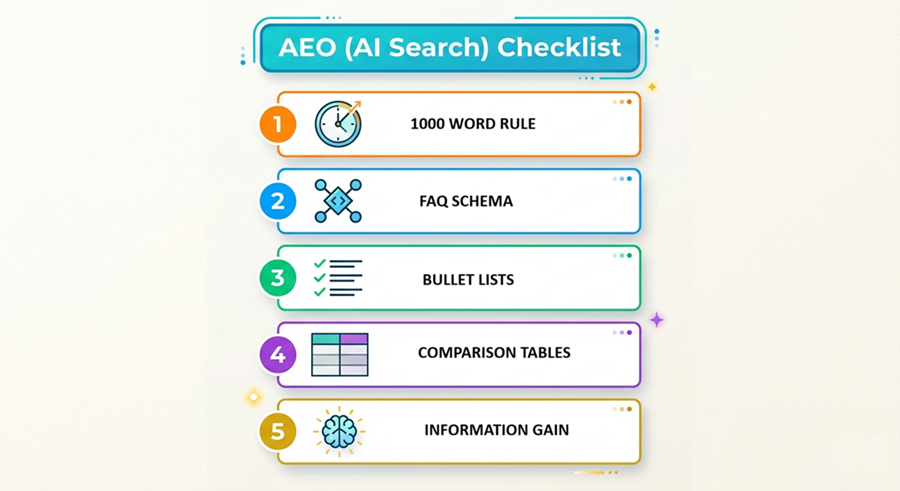
Structure your data. Use comparison tables for “Product A vs. Product B” queries. Use bulleted lists for steps. AI engines love structured data because it’s easy to parse and present to the user in a summary.
| Feature | Traditional SEO Focus | AEO Strategy (2026) |
| Primary Goal | Ranking for Keywords | Becoming the Cited Source |
| Tone | Formal/Educational | Conversational/Direct |
| Structure | Deep Narratives | “Chunkable” Answer Blocks |
Conclusion: The Future is AI-Assisted, Human-Led
As we navigate the waters of 2026, the “Perplexity AI Humanizer” isn’t a piece of software—it’s you. By leveraging AI for what it does best (research and data retrieval) and doubling down on what you do best (intuition, storytelling, and experience), you create content that is unbeatable. Don’t just settle for being a “fact-checker” for an AI; be the visionary that gives those facts a voice. Ready to start humanizing?
Frequently Asked Questions (FAQs)
1. Does using Perplexity AI hurt my SEO rankings?
Not at all. Search engines prioritize high-quality, helpful content. If you use Perplexity to gather facts and then add your own unique insights and formatting, you’re actually likely to rank higher.
2. What is “Burstiness” in writing?
Burstiness refers to the variation in sentence length and structure. AI often produces very uniform sentences. Humanizing your content involves mixing short, punchy sentences with longer, more complex ones to create a natural flow.
3. How does Generative Engine Optimization (GEO) differ from SEO?
While SEO focuses on ranking in traditional search results, GEO focuses on being the cited source in AI-generated answers. It requires a more direct, “answer-first” approach to content structure.
4. Can AI detectors really tell if I used a humanizer tool?
Most AI detectors are easily fooled and often give false positives. Instead of trying to “beat” the detector, focus on adding value that an AI couldn’t, like personal anecdotes or proprietary data.
5. What is the “100-Word Rule” in AEO?
It’s a strategy where you provide a clear, direct answer to the user’s query within the first 100 words of your content. This makes it easier for AI engines to identify and cite your information.