Introduction: The Dual-Engine Titan Redefining Global Commerce
Have you ever paused while opening a brown cardboard box on your doorstep and wondered how the exact same company delivering your toothpaste also runs the digital backbone of Netflix, Airbnb, and international governments? It feels like two completely distinct businesses hiding under one massive corporate umbrella. And honestly? That is because it is.
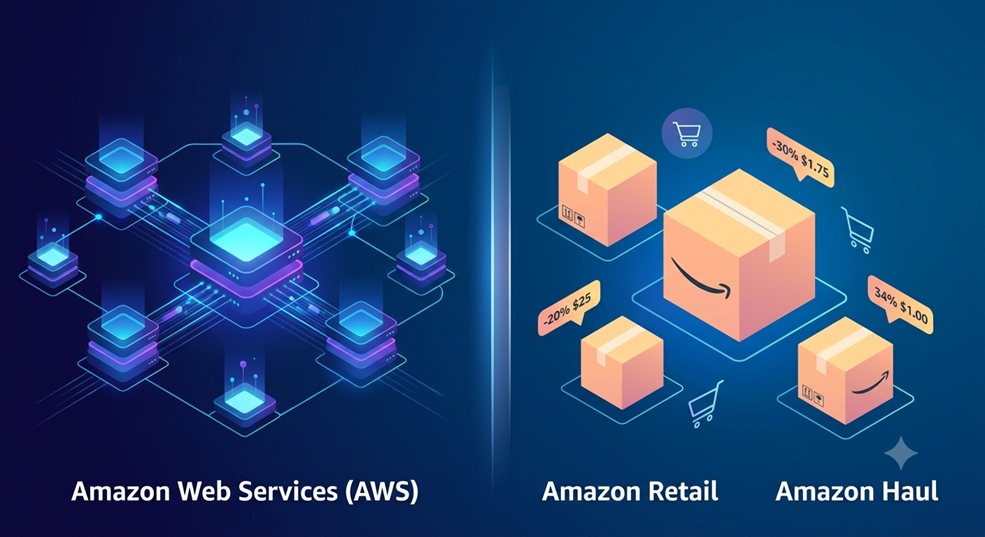
Amazon is no longer just a digital superstore or a simple e-commerce site. It has evolved into a sophisticated, dual-engine conglomerate. On one side sits a high-margin enterprise technology powerhouse, and on the other, a relentless, highly experimental retail network. To understand where digital commerce is heading, you have to look at how these two engines power each other. In this deep dive, we will break down the fundamental amazon vs amazon web services difference and explore Amazon’s boldest retail experiment yet by answering the viral consumer question: what is amazon haul?
Beyond the Cardboard Box: Understanding Amazon’s True Blueprint
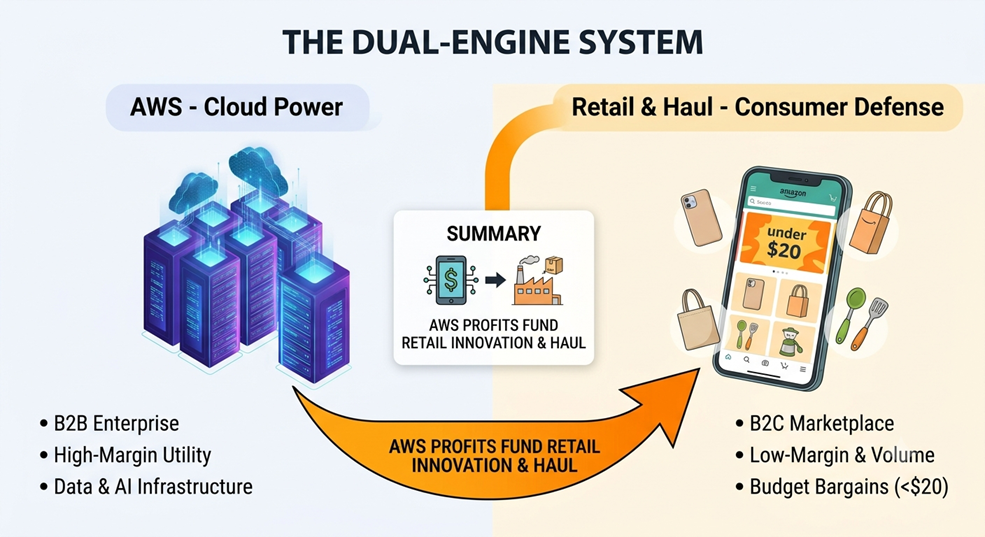
If you view Amazon purely as an online mall, you are missing the engine under the hood. The genius of Amazon’s business model lies in its ability to balance radically different margins. High-margin B2B software services absorb market shocks and provide steady cash flow, giving the company the luxury to launch low-margin B2C retail counter-offensives. It is an ecosystem where server farms literally fund shopping bargains.
Unpacking the B2B Foundation: Amazon vs Amazon Web Services Difference

To grasp the full scope of the enterprise, we first need to tackle the fundamental amazon vs amazon web services difference. While everyday consumers interact with Amazon through product searches and Prime delivery, the corporate world relies on a completely different monster: AWS.
| AMAZON CONGLOMERATE | |
| AMAZON RETAIL | Amazon Web Services (AWS) |
| Consumer MarketplacesAmazon Haul StorefrontLow Margin / High VolumePhysical Logistics | Enterprise Cloud ComputeS3 Storage & DatabasesAI & Machine LearningHigh Margin Profit Engine |
What is Amazon Web Services (AWS) and How Does It Function?
Launched in the mid-2000s, Amazon Web Services (AWS) was born out of internal necessity. Amazon had built a massive, complex digital infrastructure to handle its holiday shopping traffic spikes. Realizing other businesses needed that same scalable compute power, they began renting out their servers.
Today, AWS is the undisputed global leader in cloud computing. Instead of a company spending millions of dollars buying physical servers, setting up server rooms, and hiring IT teams, they simply rent processing power and storage space from AWS over the internet.
Core Offerings: Compute, Storage, and AI Infrastructure
AWS offers hundreds of featured services, but its operational backbone centers on three core pillars:
- Elastic Compute Cloud (EC2): Virtual servers that let companies run application code on demand.
- Simple Storage Service (S3): Highly secure, scalable cloud object storage for data, media, and backups.
- Machine Learning and AI Services: Cutting-edge managed infrastructure (like Amazon Bedrock) enabling enterprises to train and deploy Generative AI models.
The Core Differences Between E-Commerce Retail and AWS
Comparing the retail arm to AWS is like comparing a national highway system to a power plant. They serve entirely different purposes, target distinct audiences, and operate under radically different economic rules.
| Feature | Amazon Retail (Consumer) | Amazon Web Services (AWS) |
| Primary Audience | Everyday consumers & B2C shoppers | Developers, startups, enterprises, & governments |
| Business Model | Product sales, seller fees, & Prime subscriptions | On-demand, pay-as-you-go cloud utility pricing |
| Physical Assets | Fulfillment centers, delivery vans, & inventory | Global data centers, undersea cables, & server racks |
| Profit Margins | Very low (often 1% to 5%) | Exceptionally high (typically 25% to 30%+) |
| Core Function | Moving physical goods from seller to buyer | Hosting digital data, apps, and computational power |
AWS as the Financial Engine: Subsidizing Risk Across the Empire
Here is the secret sauce that most casual observers miss: AWS is the financial powerhouse of the entire company.
While the retail business generates stunning top-line revenue numbers by selling billions of physical items, moving physical boxes is insanely expensive. Warehouses, drivers, fuel, and returns eat up margins rapidly. AWS, operating as a software utility, enjoys massive profit margins. In many fiscal quarters, AWS accounts for over 60% to 70% of Amazon’s total operating income despite generating a smaller fraction of overall sales revenue.
This high-margin profit cushion changes the game entirely. It gives executive leadership the liberty to take wild market risks, absorb short-term retail losses, and build brand-new consumer platforms without facing immediate financial peril.
The Consumer Counter-Defense: What is Amazon Haul?
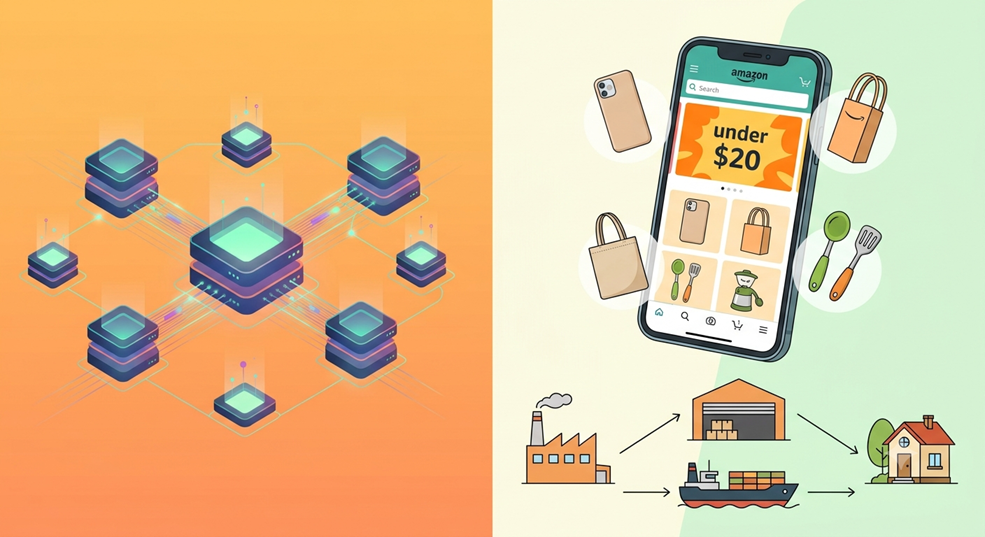
Now that we understand the financial foundation powering the empire, let’s look at how Amazon uses that freedom to protect its retail turf. Enter the newest front in the e-commerce war: Amazon Haul.
Decoding the Bargain Storefront: Pricing, Mechanics, and Sourcing
So, what is amazon haul? Launched as a dedicated discount experience inside the Amazon mobile app and mobile web, Amazon Haul is a specialized storefront built specifically for rock-bottom, ultra-budget shopping.
If you open Haul, you won’t see brand-name luxury items or high-end electronics. Instead, you will find an endless feed of fashion accessories, home organizers, kitchen gadgets, lifestyle novelty items, and basic apparel.
The Under-$20 Price Cap and Shipping Trade-Offs
Amazon Haul operates under strict rules designed to keep cart totals exceptionally low:
- Strict Price Cap: Every single item on Amazon Haul is priced at $20 or less, with the vast majority of items sitting under $10 or even under $5.
- Bulk Incentive Discounts: To drive up order sizes, Haul offers tiered savings—such as 5% off orders over $50 and 10% off orders over $75.
- The Shipping Trade-Off: Delivery takes roughly 1 to 2 weeks. Unlike standard Prime items sitting in regional warehouses nearby, Haul items are sourced directly from overseas manufacturers and direct-from-factory suppliers, shipped in consolidated batches.
How Amazon Haul Operates Differently From Regular Prime
To understand Haul, you have to realize that it completely breaks the classic “Amazon Prime” promise. For over two decades, Amazon trained consumers to demand instant gratification—same-day or two-day free shipping. Haul flips that script.
| Regular Amazon Prime | Amazon Haul | |
| Fast Delivery (1-2 Days)Higher Price PointLocal FBA WarehousesIndividual Shipments | VS | Slow Delivery (1-2 Wks)Ultra-Low Prices (<$20)Direct Overseas OriginConsolidated Batches |
Shoppers on Haul are explicitly making a trade-off: they are trading speed for ultra-low prices. Prime delivery perks do not apply here. Shipping is free only when your cart hits a minimum threshold (typically $25); otherwise, a flat shipping fee applies.
The Battle for Ultra-Low-Cost E-Commerce: Countering Temu and Shein
Why would Amazon intentionally introduce slow delivery times back into its ecosystem? The answer is simple: defense.
Platforms like Temu and Shein exploded in popularity by leveraging direct-from-factory shipping models that bypassed traditional distribution networks, letting them sell items for pennies on the dollar. Budget-conscious consumers, especially Gen Z, showed they were perfectly willing to wait ten days for a package if it meant saving 70%.
Amazon Haul is Amazon’s direct counter-offensive. By creating a distinct, isolated budget storefront, Amazon can battle ultra-discount rivals on price without cheapening the core Amazon Prime experience or confusing buyers who expect two-day shipping on standard orders.
The Strategic Synergy: Infrastructure Funds Innovation
When you connect the dots between the amazon vs amazon web services difference and the mechanics of what is amazon haul, the bigger picture becomes crystal clear. This is where the core narrative—“Infrastructure Funds Innovation”—comes to life.
| THE DUAL-ENGINE SYSTEM | ||
| AWS CLOUD (High-Margin B2B) | AMAZON HAUL (Low-Margin B2C) | |
| Provides Operating Income | ||
| AWS generates reliable, multi-billion-dollar profit marginsCash reserves absorb the low-margin risks of ultra-cheap B2CAmazon defends market share without risking financial health |
How High-Margin B2B Tech Enables Aggressive B2C Experiments
Building a brand-new retail infrastructure, setting up factory-direct logistics channels, and running marketing campaigns for ultra-cheap items costs massive amounts of money. If Amazon were only a retail store operating on thin 2% margins, taking a massive gamble like Amazon Haul would be terrifying. A bad stretch of quarterly losses could destabilize the business.
However, because AWS generates billions in predictable, high-margin profit month after month, Amazon can treat retail experiments like R&D labs. AWS provides the safety net. If Amazon Haul takes time to reach profitability, it doesn’t matter—AWS keeps the lights on and the stock price stable while the retail team iterates, scales, and captures market share.
Market Defense Mechanics: Protecting Customer Acquisition Funnels
In modern digital business, customer retention is everything. If a buyer leaves Amazon to purchase cheap accessories on Temu, Amazon loses more than just a $5 sale—they lose customer attention, search volume, and habit forming behavior.
By running Haul, Amazon traps budget-minded traffic inside its own app ecosystem. A user might buy a $4 phone case on Haul today, and three days later, use the exact same app to buy a $300 appliance on regular Amazon. AWS funds the moat that keeps customers from ever needing to shop anywhere else.
Strategic Takeaways for Brands, Sellers, and Digital Marketers
For digital strategists, e-commerce brand managers, and agency leaders analyzing market trends, Amazon’s dual-engine approach carries vital business lessons.
Navigating Category Compression and Pricing Pressure
The rise of platforms like Amazon Haul signals a permanent shift in consumer expectations around commodity goods. If your brand sells unbranded, generic products (like basic cables, plastic organizers, or simple totes), you are now competing directly with factory-floor pricing.
To survive this shift, brand owners must focus on:
- Value-Add Differentiation: Creating authentic brand identity, custom product engineering, and superior quality that cannot be replicated for $3.
- Focusing on High-Trust Categories: Consumers will gladly buy a $2 silicone spatula on Haul, but they still prefer established brands for skincare, electronics, baby products, and safety-critical items.
Lessons in Brand Ecosystem Diversification
The ultimate takeaway from studying the amazon vs amazon web services difference is the power of business model balance. Single-stream revenue models are inherently vulnerable.
Whether you are running a SaaS startup or a direct-to-consumer digital agency, building a dual-engine framework—balancing high-margin service/software offerings with wide-reach, customer-acquiring products—is the single best way to future-proof your growth against market shifts.
Conclusion: What Amazon’s Blueprint Means for the Future of Tech
Amazon’s rise from an online bookstore to a multi-trillion-dollar titan is not an accident of history—it is a masterclass in structural business design.
By building a powerhouse enterprise service in AWS, Amazon unlocked the financial superpowers required to continuously disrupt consumer commerce. Understanding the amazon vs amazon web services difference highlights why traditional retailers struggle to compete: they are fighting a software company that happens to own a retail fulfillment network. And when you look at what is amazon haul, you see that same strategic engine in action—using B2B stability to fuel ultra-aggressive consumer agility.
As digital landscapes shift toward AI integration and changing consumer habits, one thing remains certain: the businesses that master both enterprise backend infrastructure and customer-facing innovation will be the ones defining the future of global trade.
Frequently Asked Questions (FAQs)
1. Can I use my existing Amazon account to shop on Amazon Haul?
Yes! You do not need to create a new profile or register a separate account. You can access Amazon Haul directly through your existing Amazon mobile app or website. However, items added to your Haul cart remain in a separate Haul checkout cart rather than mixing with your regular Amazon shopping cart.
2. Is AWS only for massive tech enterprises, or can small businesses use it?
AWS is designed for organizations of every size, from solo web developers and small startups to Fortune 500 enterprises. Because AWS operates on a pay-as-you-go utility model, a small business can host a simple site or database for just a few dollars a month and scale up resources as the business grows.
3. Why don’t Prime membership benefits apply to Amazon Haul purchases?
Amazon Haul keeps product prices exceptionally low by shipping items directly from overseas manufacturers in consolidated batches, rather than storing them locally in high-cost domestic fulfillment centers. Because fast 1-to-2 day shipping requires local warehousing, Amazon keeps Haul prices low by removing Prime speed guarantees and using 1-to-2 week standard transit instead.
4. How does AWS make so much more profit than Amazon’s online store?
AWS sells digital software infrastructure—processing power, data storage, and network bandwidth—which has extremely low ongoing distribution costs once server farms are built. On the flip side, physical retail requires expensive human labor, physical warehouses, packaging materials, shipping fleets, and returns processing, which constantly slice into retail profit margins.
5. Are items on Amazon Haul covered by Amazon’s buyer protection rules?
Yes. Even though shipping times are longer and products come from budget manufacturers, purchases made through Amazon Haul are still backed by Amazon’s standard buyer protection guarantee. Eligible items can generally be returned within 15 days of delivery, giving shoppers a familiar layer of safety compared to third-party discount apps.