1. Introduction: The Quiet Revolution in Your Browser
Remember when searching the web meant typing three keywords into a box, pressing enter, and clicking through a endless trail of blue links? You’d spend fifteen minutes opening tabs, skimming paragraphs, and stitching together answers yourself.
That era is officially coming to a close.
We’ve crossed the threshold into a completely different era of the web—one driven not by simple information retrieval, but by true digital intelligence. At the epicenter of this shift sits Google Gemini AI. But if you still think of Gemini as “just another chatbot” competing for conversational airtime alongside ChatGPT or Claude, you are missing the bigger picture.
Gemini isn’t just a fancy text box; it is an fundamental infrastructure overhaul of the entire internet ecosystem. It represents the jump from static search engines to dynamic digital assistants capable of reasoning, executing, and understanding the world visually, aurally, and contextually.
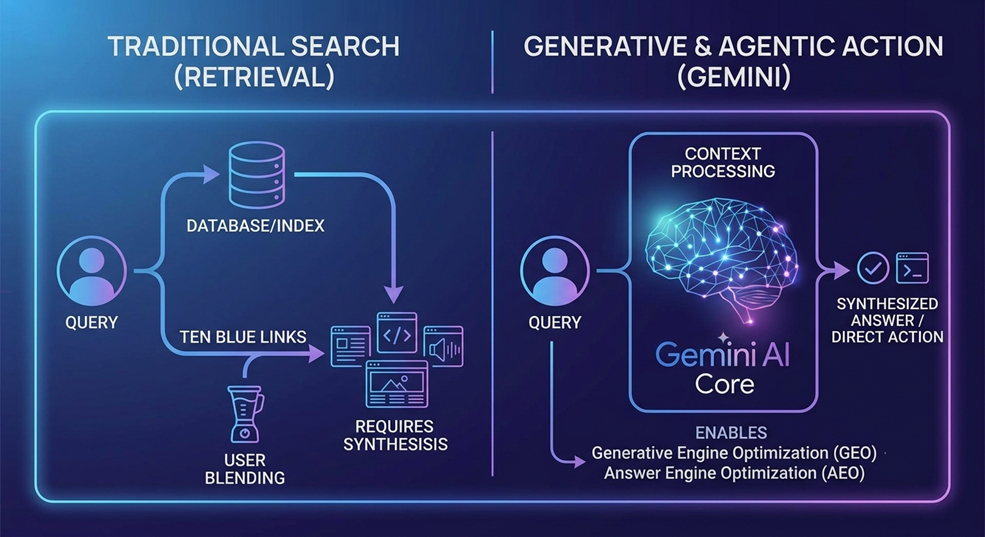
[Traditional Search] –> Query -> Index -> Ten Blue Links -> Manual Synthesis
[Digital Intelligence] –> Multimodal Input -> Context Processing -> Executable Action
1.1 Beyond the Chatbot Hype
When generative AI first exploded into public consciousness, most models felt like clever novelties. You could ask for a poem about a toaster, debug a tiny snippet of Python, or rewrite an email to sound more professional. But behind the scenes, those early tools had massive blind spots. They were text-heavy engines retrofitted with makeshift plugins to process images or audio.
Google Gemini threw out that playbook entirely. Instead of bolting external tools onto a text engine, Google built a model that views every piece of information—whether it’s a line of code, a video clip, or an audio recording—as natively equal language.
1.2 Defining “Digital Intelligence”
What does “Digital Intelligence” actually mean in practice? It’s the ability of a system to perceive raw, messy human input, cross-examine it against massive real-time datasets, and draw logical conclusions without needing explicit step-by-step programming.
It is the shift from passive tools that wait for commands to active infrastructure that works alongside us.
2. The Native Advantage: Built Multimodal from Day One
Imagine trying to teach someone how to paint a picture, but you can only communicate using text descriptions sent over a telegraph. That’s how older text-first AI models tried to understand the physical world. They translated visuals into text tags, analyzed the text, and translated the response back into pixels. Information got lost in translation at every turn.
Old Approach: Image -> Text Conversion -> Text Model -> Output (Lossy)
Gemini Approach: Image + Video + Audio + Text -> Native Multimodal Engine -> Precise Action
2.1 Why Text-First AI Met Its Limits
Earlier Large Language Models (LLMs) were brilliant, but inherently constrained. They understood grammar, syntax, and vocabulary with terrifying accuracy, but they lacked spatial awareness, temporal context, and the subtle nuances of human sound. When you fed a video clip into an adapted text model, it didn’t actually see the video; it read a sequence of sampled image descriptions.
2.2 Processing Code, Audio, Video, and Imagery Simultaneously
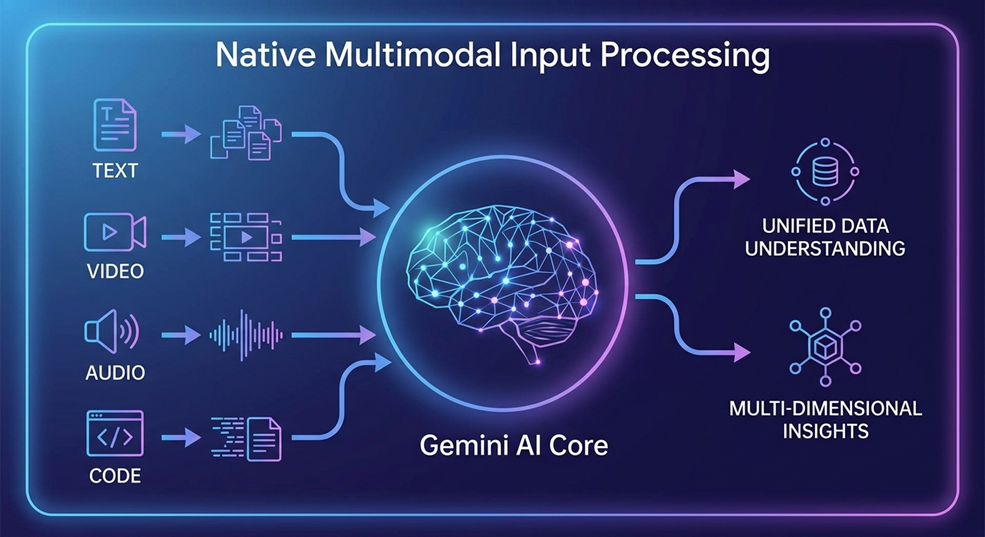
Google Gemini’s breakthrough lies in its native multimodality. From the moment its foundation weights were laid down, it was trained on interwoven data streams.
What does this mean for you?
- You can record a complex 15-minute whiteboard presentation, upload the raw video file, and ask Gemini to write the functional code for the architecture drawn on the board.
- You can feed it an engine noise audio file alongside a photo of your car’s dashboard, and it can cross-reference sound patterns with visual diagnostics.
It doesn’t jump between separate tools behind the curtain; it processes all these senses within a unified neural engine.
2.3 Millions of Tokens: The Power of Long-Context Windows
The true engine powering this leap is Gemini’s unprecedented long-context window. While earlier models choked when reading documents longer than a few dozen pages, Gemini easily swallows millions of tokens in a single prompt.
Think of it this way: A small context window is like having short-term memory loss—you have to constantly remind the AI what you were talking about 10 minutes ago. A million-plus token context window is like handing the AI a 1,000-page operational manual or an entire codebase, and having it memorize every line instantly.
You can upload entire legal archives, annual financial reports, or complete video courses, and query them with razor-sharp precision in seconds.
3. From Search Engine to Answer Engine & Autonomous Agent
If you run a business, manage a website, or direct a digital marketing strategy, this is where the ground beneath your feet truly moves. For twenty-five years, web visibility followed a simple formula: target a keyword, optimize on-page SEO, build backlinks, and win top placement on the Google Search Results Page (SERP).
Gemini has fundamentally rewritten that bargain.
Standard Search: Keyword -> Matching Webpages -> Traffic
Generative Search: Intent -> Multimodal Context -> Direct Synthesized Answer
3.1 The Demise of the “Ten Blue Links” Paradigm
Users no longer want to click four different articles to find out how to fix a leaking pipe or calculate a mortgage payoff schedule. They want immediate, actionable, and hyper-personalized answers. Search is morphing into a direct conversation—a transition driven by Gemini powering AI Overviews globally.
Instead of serving as a digital traffic cop pointing visitors down different highways, Google is becoming the ultimate destination—synthesizing data on the fly.
3.2 AI Overviews and the Rise of Generative Engine Optimization (GEO)
Welcome to the era of Generative Engine Optimization (GEO). If your content is just generic fluff rephrased from existing web pages, Gemini will digest it, summarize it, and present it directly on the SERP without ever sending a single visitor to your site.
To survive and rank in an AI-dominated web, content creators must provide:
- Original Research & Primary Data: Facts that the AI hasn’t seen anywhere else.
- Clear Entity Relationships: Structured data that makes it effortless for Gemini to understand who you are, what you do, and why you are an authority.
- High Density of First-Hand Experience: Genuine human perspective that AI synthesis cannot replicate.
3.3 Answer Engine Optimization (AEO): Winning the Synthesized Response
Alongside GEO sits Answer Engine Optimization (AEO). AEO focuses on formatting your business information so clearly that Gemini selects your data to build its direct answers. Whether it’s direct product comparison matrices, structured schema markups, or direct Q&A blocks, optimizing for AEO ensures your brand remains visible inside the AI-generated snapshot.
4. The Deep Ecosystem Integration: An AI Embedded Everywhere
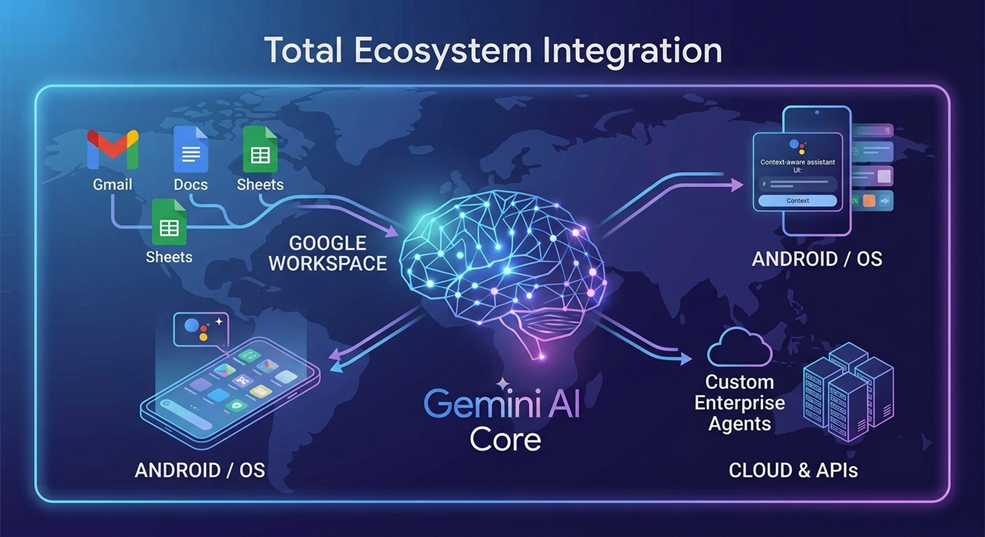
A common mistake is viewing Gemini as an isolated destination website like gemini.google.com. The real strategy behind Google’s roadmap is complete, frictionless ambient intelligence.
| GOOGLE GEMINI AI | ||
| | | | | | |
| [Google Workspace] Docs & Gmail Sheets & Slides | [Android / OS] System-Wide Context | [Cloud & APIs] Custom Enterprise Agent Deployment |
4.1 Invisible AI in Google Workspace and Android
The most effective technology is the kind you barely notice because it feels like an extension of your own hand. Gemini is woven straight into the fabric of Google Workspace and Android OS.
- In Google Docs: It acts as an inline co-writer that understands the context of your entire team’s Shared Drive.
- In Gmail: It drafts responses based on ongoing, multi-thread email histories.
- On Mobile: It operates as a context-aware system layer. You can bring up Gemini over any open app on your phone, ask it to summarize a PDF you just received in a message, and immediately schedule a calendar invite based on the dates listed inside that document.
4.2 Transforming Developer Workflows with Cloud and API Infrastructure
For developers and enterprise leaders, Gemini isn’t just an assistant—it’s a foundation to build on. Through Google Cloud Vertex AI and the Gemini API, businesses are deploying customized enterprise models that sit securely on top of their proprietary data. From automated customer support bots that actually resolve complex, multi-tiered issues to automated code refactoring pipelines, Gemini acts as the backend engine for modern software development.
5. Agentic AI and Complex Reasoning: The Ultimate Strategic Shift
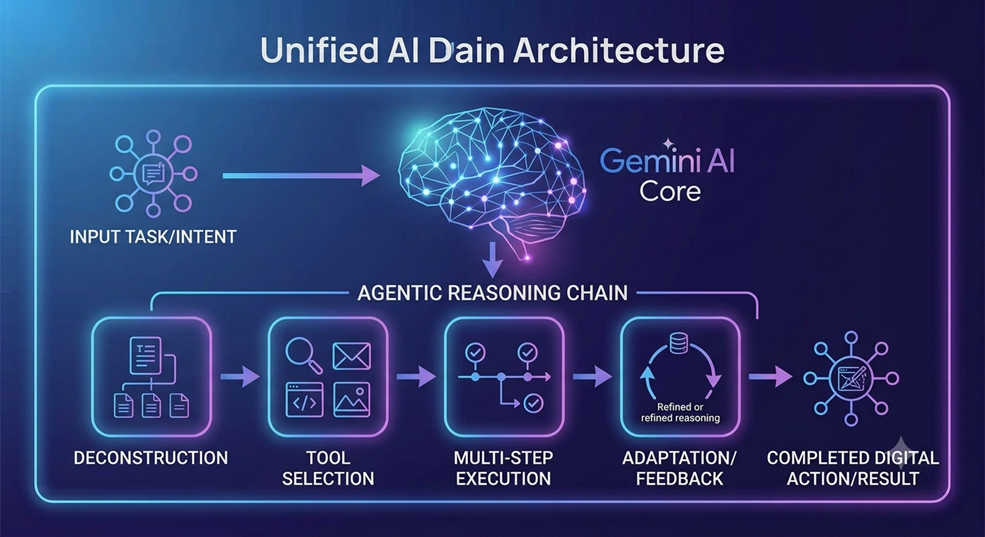
We are witnessing the bridge between basic text generation and Agentic AI—systems that don’t just talk, but actually do.
Generation Model: “Here is a step-by-step plan on how to book your trip to Tokyo.”
Agentic Model: “I have cross-checked flight prices, evaluated hotel reviews, drafted your itinerary, and put the held reservations in your cart.”
5.1 From Generating Content to Executing Multi-Step Actions
Traditional models were passive; you asked a question, and it produced text. Agentic AI takes intent and executes a chain of reasoning across multiple tools:
- Deconstruction: It breaks down a complex task (“Organize a local product launch event”) into smaller logical sub-tasks.
- Tool Selection: It accesses calendar schedules, contacts, email drafts, and supplier forms.
- Execution & Adjustment: It carries out tasks sequentially, adjusting its plan if a tool fails or returns unexpected data.
Gemini’s advanced reasoning capabilities allow it to execute these multi-step workflows with incredible precision, acting as an autonomous digital staff member.
5.2 Real-World Impact on Business Operations and Data Pipelines
Consider how this transforms standard business workflows:
- Market Research: Instead of manually gathering competitor pricing, an agentic Gemini setup can pull data from multiple web sources, format it into a clean spreadsheet, run statistical anomaly checks, and draft a summary report for management—all on a automated schedule.
- Customer Support: Customer interactions shift from frustrating keyword bots to intelligent agents capable of processing refunds, updating shipping details, and verifying identity across secure backend systems.
6. What Marketers, Businesses, and Creators Must Do Next
If Gemini represents the future of digital intelligence, how do you adjust your business strategy today?
- Shift Focus from Keywords to Intent Entities: Stop writing content just to hit a keyword density target. Focus on comprehensively answering the broader problem space surrounding your niche.
- Publish Proprietary Insights: AI can synthesize existing information effortlessly, but it cannot invent original insights, conduct original interviews, or share lived human experiences. Your original perspective is your ultimate competitive moat.
- Build an API-First Infrastructure: Prepare your business systems so that AI agents can interact with your products. If an AI agent can’t navigate your checkout process or retrieve your inventory data easily, you will miss out on the growing wave of agentic-driven commerce.
- Embrace Multimodal Content Strategy: Don’t limit your content footprint to text. Produce videos, podcasts, infographics, and structured data tables. Because Gemini processes all formats natively, a rich multimodal footprint exponentially increases your digital visibility.
7. Conclusion: Stepping Into the Future of Digital Action
Google Gemini AI is far more than a stepping stone in the ongoing AI race; it is a fundamental shift in how human intelligence interacts with digital networks. By building a natively multimodal model with vast long-context processing, deep system-wide integration, and autonomous reasoning capabilities, Google has shifted the digital landscape from static search to dynamic action.
The future of digital intelligence belongs to those who stop treating AI like a novelty search bar and start building around it as a core platform. Whether you are an enterprise executive, a solo developer, or a content strategist, understanding this paradigm shift isn’t just an advantage anymore—it’s the blueprint for staying relevant in an AI-first economy.
8. Frequently Asked Questions (FAQs)
1. What makes Google Gemini AI different from ChatGPT?
While both are advanced AI systems, Gemini was designed from the ground up to be natively multimodal. This means it processes text, code, audio, images, and video simultaneously within the same core engine without relying on separate plugins or secondary processing tools.
2. How does Google Gemini affect traditional SEO?
Gemini powers features like AI Overviews, which synthesize direct answers at the top of search results. This shifts the focus from traditional keyword optimization toward Generative Engine Optimization (GEO) and Answer Engine Optimization (AEO), where visibility depends on domain authority, structured data, original research, and clear entity relationships.
3. What is meant by “Long-Context Window” in Gemini?
A long-context window refers to the volume of information the AI can hold in its active memory at one time. Gemini’s ability to process millions of tokens allows users to feed it entire books, hours of video, or thousands of lines of code in a single prompt without losing detail or context.
4. Is Google Gemini AI available inside Google Workspace apps?
Yes, Gemini is deeply integrated across the Google Workspace suite, including Google Docs, Gmail, Sheets, Drive, and Slides, serving as an inline assistant that understands your organization’s context to help draft, organize, and analyze data.
5. What is Agentic AI and how does Gemini utilize it?
Agentic AI refers to AI systems capable of autonomous reasoning and multi-step task execution. Instead of just answering questions, an agentic Gemini system can break down complex instructions, interact with external software tools, manage data workflows, and execute tasks independently from start to finish.