Introduction
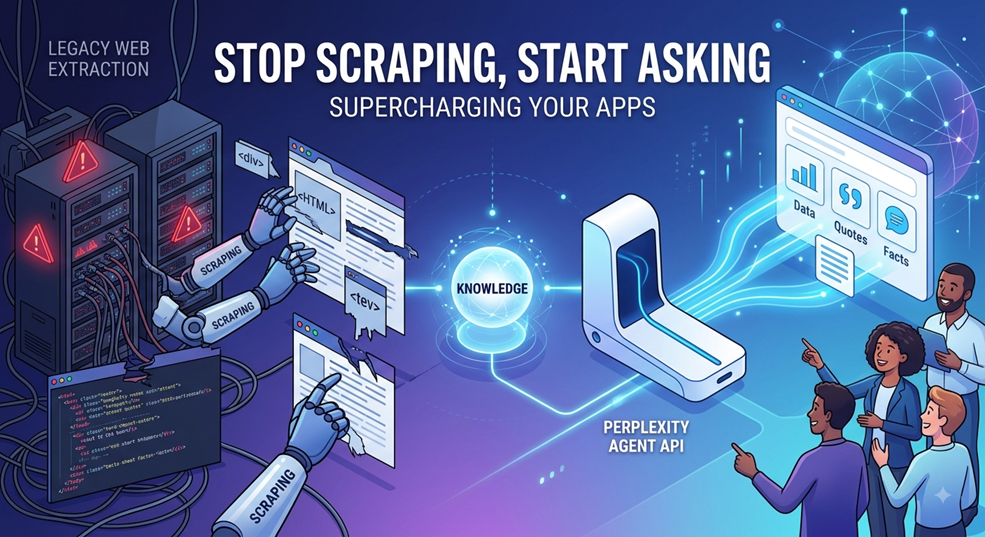
If you have ever built a software product that relies on live web data, you know the dark truth: traditional web scraping is an absolute nightmare.
One day your pipeline runs smoothly, and the next, a target site updates its CSS classes. Suddenly, your parser crashes, your database fills with unparsed garbage, and your error logs light up like a Christmas tree. If the DOM change does not get you, cloud security providers will. You end up playing a perpetual game of cat-and-mouse with IP rotation, headless browser management, and anti-bot challenges.
What if you could delete that entire scraping codebase today?
We are moving away from procedural web extraction toward declarative, agentic retrieval. Instead of telling your app how to extract, clean, parse, and process raw HTML, you simply tell an API what you want to know. The Perplexity Agent API shifts the burden of web execution from your infrastructure to an autonomous reasoning engine.
Here is how replacing fragile scrapers with intent-driven agent API calls can supercharge your software stack.
The Nightmare of Legacy Web Extraction
Building web-aware applications used to require massive engineering overhead. To get real-time information into your software, you had to construct elaborate pipelines to fetch web pages, clean raw text, and force it into your app’s memory.
The Fragile Web Scraping Stack
The traditional scraping stack resembles a tower of cards built on quicksand. You start with standard HTTP requests, but those get blocked immediately. So, you bring out heavy headless browsers like Playwright or Selenium.
Proxies, CAPTCHAs, and DOM Breakages
Before you know it, your code is bogged down with complex infrastructure:
- Rotating Proxy Networks: Managing pools of residential and datacenter IPs just to pass basic network firewalls.
- CAPTCHA Bypass Services: Paying third-party solvers to get around security checks.
- Fragile DOM Parsers: Writing bespoke CSS selectors and XPath queries that break every time a target site updates its UI layout.
You aren’t spending your engineering hours building core product features; you are acting as full-time web infrastructure plumbing repair crew.
The Bottlenecks of Traditional RAG Pipelines
To make matters worse, simple Retrieval-Augmented Generation (RAG) pipelines often fail when processing dynamic web data.
Context Clutter and Token Waste
When you scrape a web page, you fetch everything—navbars, footers, ad scripts, tracking pixels, and cookie consent banners. Passing thousands of lines of raw HTML or poorly stripped text into an LLM context window burns through token budgets at alarming speeds. More importantly, it dilutes the model’s focus, introducing noise that leads to hallucinations or incomplete answers. Single-pass RAG queries simply cannot handle complex research tasks that require following multi-step trails across multiple sites.
The Core Paradigm Shift: Declarative Retrieval over Procedural Pipelines
The solution is simple: stop scraping and start asking.
What Is the Perplexity Agent API?
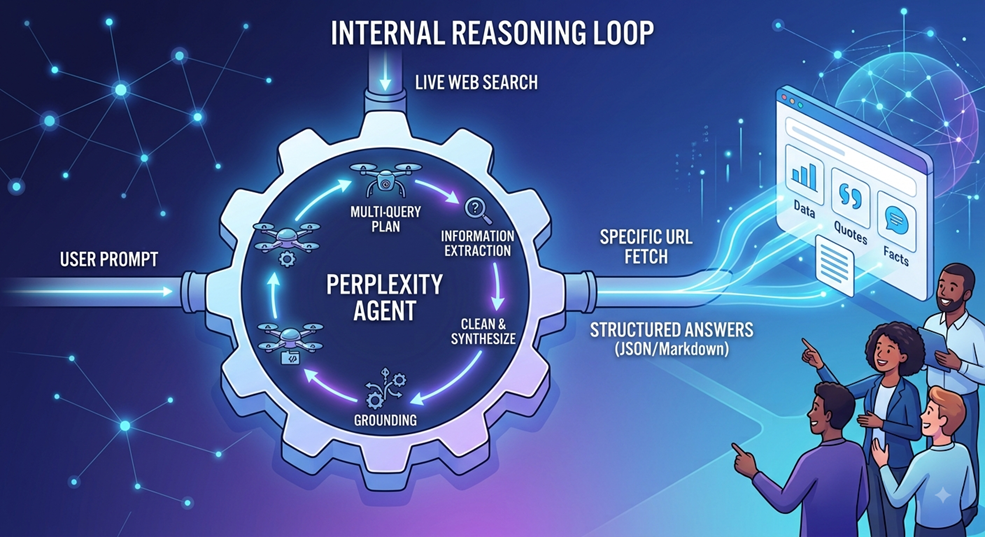
The Perplexity Agent API is a managed, autonomous runtime designed specifically for information discovery. Instead of acting as a static text-completion endpoint, it functions as an active research assistant. You pass a high-level user prompt or query, and the API takes ownership of the entire search, navigation, extraction, and synthesis loop.
How Autonomous Reasoners Execute Search
Behind the scenes, the API doesn’t just execute a single Google search and parse the top result. It operates as an iterative reasoning agent.
Multi-Query Iteration and Tool Selection
When given a complex task, the agent breaks the problem down. It uses native tools like search and page fetching to execute initial queries, analyze the results, identify missing information, and run follow-up queries. It filters out irrelevant domains, extracts key data points on the fly, and synthesizes a structured response—all within a single API interaction.
Core Engineering Benefits for Developers
Switching from custom scraping pipelines to an agentic retrieval model provides immediate architectural advantages.
Radical Stack Simplification
Imagine deleting thousands of lines of messy scraping code. With the Perplexity Agent API, your backend architecture condenses into a single HTTP POST request. You no longer need to maintain:
- Headless browser clusters (Puppeteer/Selenium)
- Scraping middleware and proxy routing logic
- Vector databases used strictly for temporary web page chunking
- Custom HTML sanitization libraries
Cost, Speed, and Latency Control via Presets
Not every application query requires deep web analysis. The API allows you to tune your request parameters based on your specific latency and cost requirements. Whether you need a lightning-fast response using lightweight model configurations or exhaustive research using multi-step search loops, you can adjust execution presets to balance speed against token expenditure.
Real-Time Data Grounding and Native Attribution
One major flaw of traditional LLMs is their lack of verifiable sources. The Perplexity Agent API addresses this by returning structured citations alongside its responses. Every fact, statistic, or update provided by the API links back to verified live web sources. This allows your application to present users with clear, clickable attributions without requiring you to build custom string-matching code.
Architecture Shift: Before vs. After
Let’s look at how your system design changes when you abandon legacy extraction.
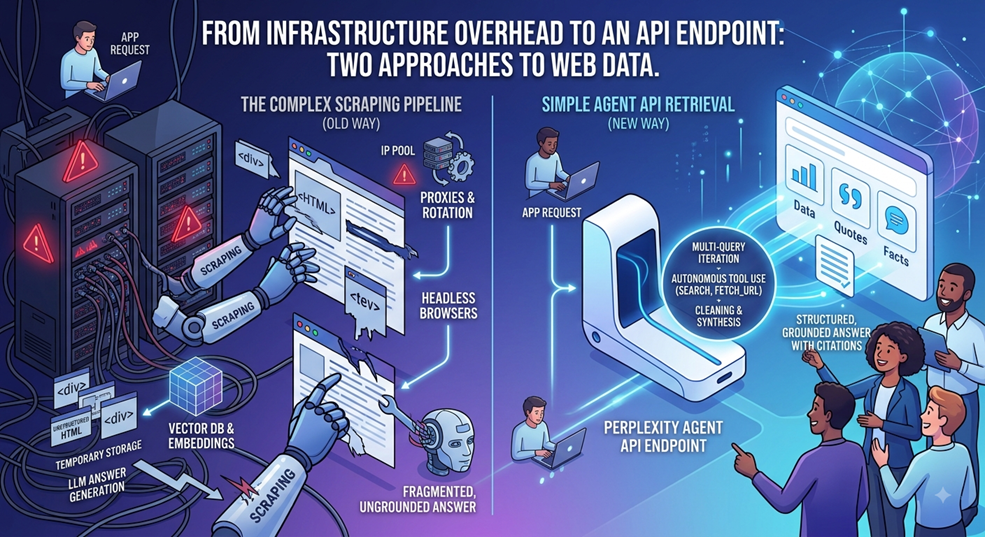
The Old Way: The 6-Step Scraping & Embedding Loop
- Trigger: User asks a question requiring real-time web data.
- Dispatch: App sends a request through a rotating proxy to launch a headless browser.
- Fetch & Parse: Browser renders page, bypasses anti-bot scripts, and extracts raw HTML via CSS selectors.
- Clean & Chunk: Backend strips scripts/ads, splits text into chunks, and generates vector embeddings.
- Vector Store Search: Chunks are temporarily stored and queried to find relevant passages.
- LLM Generation: Relevant passages are passed into a standard LLM to generate an answer.
Result: High latency, high compute costs, fragile code, and frequent pipeline failures.
The New Way: Single-Endpoint Intent Processing
- Trigger: User asks a question requiring real-time web data.
- API Call: App sends an intent-based prompt directly to the Perplexity Agent API endpoint.
- Synthesized Response: API autonomously searches, reads, evaluates, and synthesizes verified web results into a single structured payload.
Result: Minimal code footprint, predictable execution, zero scraper maintenance, and built-in citations.
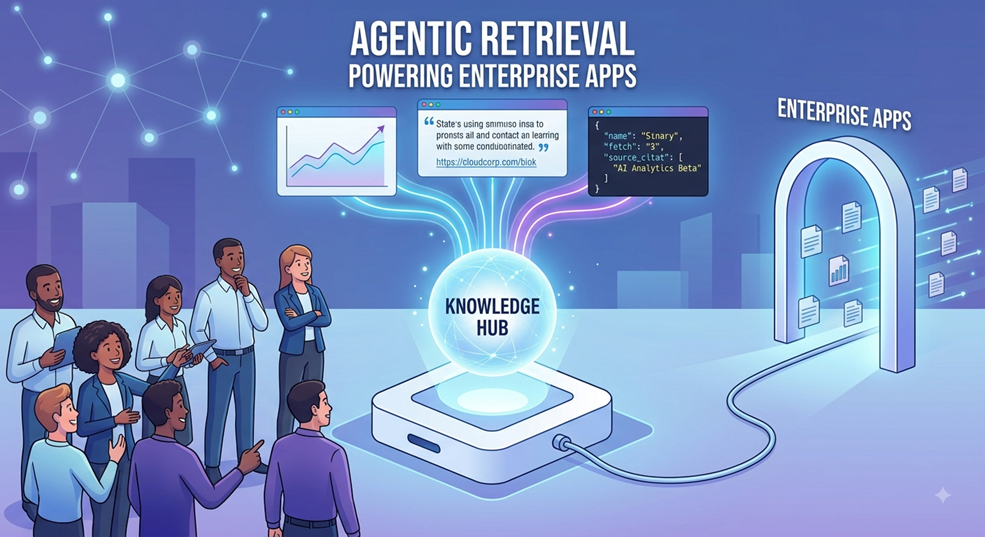
Real-World Enterprise Use Cases
How are modern product teams leveraging agentic search APIs to replace legacy scraping setups?
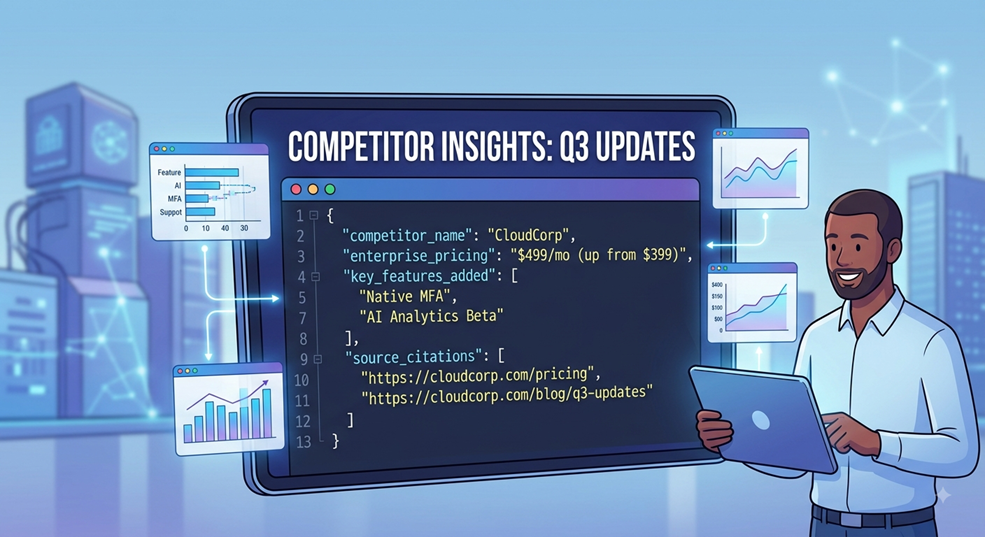
Automated Competitor Intelligence
Instead of building custom scrapers for pricing pages, press releases, and product documentation across dozens of competitor websites, you can programmatically ask the API to monitor market shifts.
Prompt Example: “Extract the latest enterprise tier pricing, features, and recent API updates announced by [Competitor X] over the last 30 days. Format as a structured JSON object.”
The API performs the research across multiple sources, handles site navigation, and delivers clean, structured insights directly into your dashboard.
Dynamic Market Research and Sales Enrichment
B2B platforms often spend massive budgets enriching lead records. Rather than querying multiple static databases or scraping social profiles, your CRM can invoke the Agent API to generate live account dossiers prior to sales calls. The API gathers real-time news, executive shifts, financial filings, and recent product launches for targeted accounts instantly.
Conclusion
Web scraping was a necessary evil during the early days of the web-aware AI applications, but its era of dominance is coming to an end. Managing headless browsers, proxy networks, and fragile DOM parsers is an inefficient use of engineering resources.
By shifting to the Perplexity Agent API, you transform web research from a complex infrastructure problem into a simple, declarative API call. You gain higher data reliability, lower operational overhead, native source attribution, and faster development cycles. Stop fighting scrapers—start asking the web directly.
Frequently Asked Questions (FAQs)
1. How does the Perplexity Agent API differ from a standard Search API (like Google Custom Search)?
A standard search API returns a list of raw URLs and snippets, leaving you to fetch, parse, and analyze the content. The Perplexity Agent API carries out the actual research process: it queries the web, reads pages, follows links, evaluates findings, and synthesizes a direct, comprehensive answer with cited sources.
2. Will using an Agent API cost less than running my own scraping infrastructure?
In most production setups, yes. When calculating the total cost of web scraping, you must factor in proxy network fees, CAPTCHA solver subscriptions, headless browser server resources, and engineering maintenance hours. An Agent API consolidates these costs into a clear pay-per-request model while reducing developer overhead.
3. Can the Perplexity Agent API output structured JSON data for direct app integration?
Yes. You can instruct the API to format its final answers into specific structured formats, such as JSON schemas, markdown tables, or precise bullet lists, making it easy to feed data directly into your frontend or downstream application services.
4. How does the API handle anti-bot protections on target websites?
The Perplexity Agent API relies on Perplexity’s underlying search index and real-time retrieval infrastructure to access and index live web content. This removes the burden of managing proxies, user agents, and anti-bot bypass mechanisms from your dev team.
5. Is the data returned by the Perplexity Agent API updated in real time?
Yes. Unlike standard LLMs that rely exclusively on static training datasets, the Agent API queries the live web dynamically when processing requests. This ensures your application receives up-to-the-minute information, breaking news, and current real-time metrics.