
Introduction
80% of enterprise AI projects stall out—not due to a lack of technology, but due to the sheer chaos of managing it. We were promised a frictionless future where autonomous software does the heavy lifting, yet modern teams find themselves drowning in subscription tools, broken API connections, and inconsistent outputs. Welcome to the software jungle of the late 2020s.
Instead of liberating team bandwidth, early AI adoption has left many organizations stuck in a mess of fragmented workflows. But here is the secret: AI complexity isn’t a dead-end technical glitch—it’s a massive strategic opportunity. If you can untangle the knot while your competitors are still buying shiny new subscriptions, you build an operational moat that no single algorithm can cross.
What is the AI Complexity Trap?
The AI Complexity Trap is an operational state where an organization deploys multiple disjointed artificial intelligence tools, resulting in fragmented workflows, corrupted data pipelines, high subscription costs, and zero measurable return on investment. It occurs when companies treat AI integration as a quick plug-and-play software upgrade rather than a structural transformation.
The Three Layers of AI Bloat
To escape the trap, you first need to recognize how it manifests across your day-to-day operations.
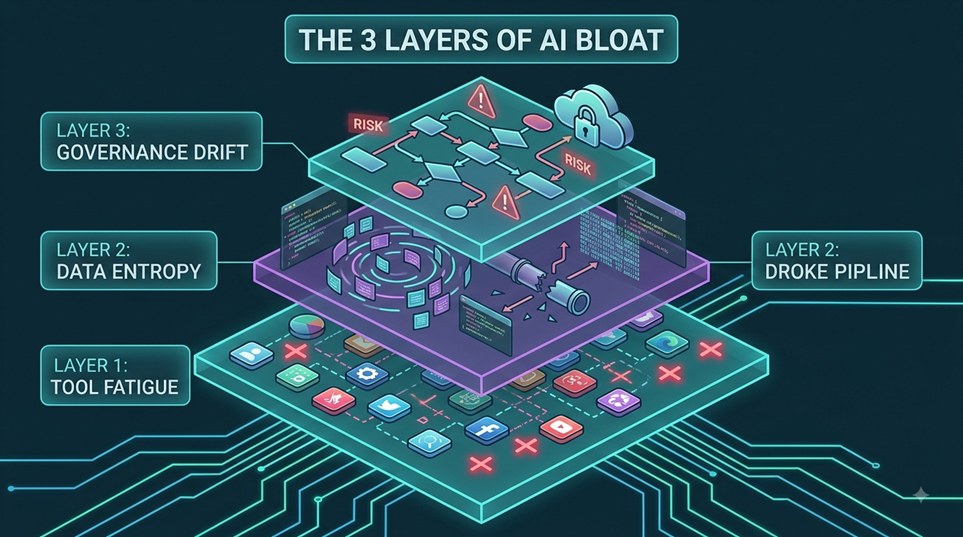
Layer 1: Tool Fatigue and Point-Solution Overload
Every department seems to have its own favorite micro-tool. Marketing uses one app for copywriting, design uses another for generation, and sales runs a third for outreach scripts. This piecemeal strategy creates isolated silos, ballooning software budgets, and an overworked staff forced to copy and paste context back and forth across a dozen browser tabs.
Layer 2: Data Entropy and Unstructured Noise
An AI engine is only as effective as the context you feed it. When company data is scattered across messy Google Drives, outdated Notion pages, and buried Slack threads, generative models panic. They draw on contradictory information, producing generic or completely inaccurate content.
Layer 3: Governance Drift and Hallucination Risks
Without clear guardrails, employees use public LLMs with unverified prompts. This creates serious brand risks: unvetted brand voices, leaked corporate data, and hallucinated factual claims that can undermine customer trust overnight.
Why Traditional SEO Tactics Fail in the GEO Era
If your strategy relies on standard 2010s keyword stuffing to gain web traffic, you are fighting a losing battle. Search engines have evolved into direct answer systems.
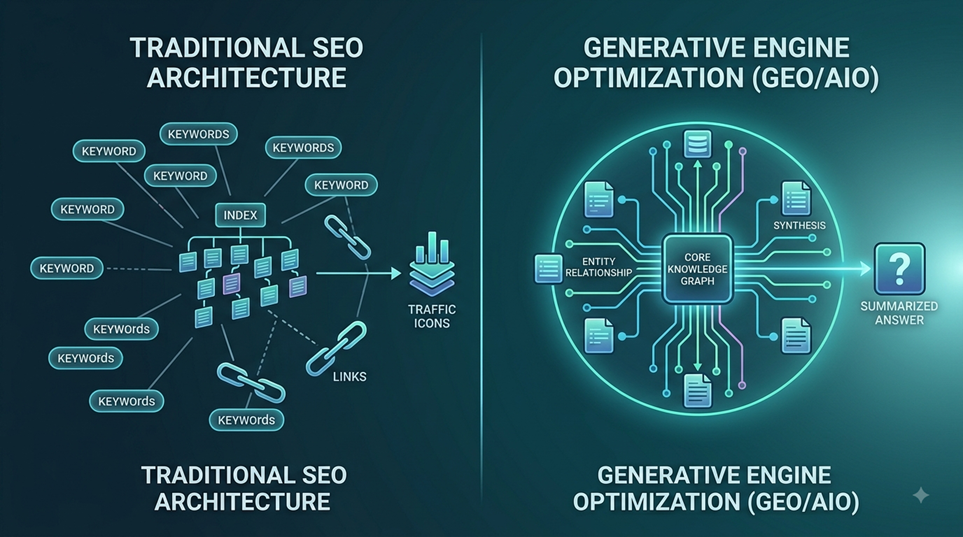
The Shift from Keyword Stuffing to Generative Engine Optimization (GEO)
Generative Engine Optimization (GEO) and Answer Engine Optimization (AEO) prioritize depth of information, clear entity relationships, and synthesis-ready structure over repetitive keyword mentions. AI answer engines (like Perplexity, ChatGPT, and Google AI Overviews) extract concise facts rather than serving up blue links. If your content lacks clear definitions and structured data, these systems simply pass you by.
Comparative Architecture: Legacy vs. Modern AI Integration
| Feature | Legacy AI Strategy (The Chaos Trap) | Simplified AI Architecture (The Moat) |
| Tool Deployment | Fragmented point-solutions per team | Unified orchestration layer |
| Data Strategy | Raw, unstructured, scattered inputs | Clean RAG architecture & unified knowledge bases |
| Search Focus | Basic keyword optimization (SEO) | Generative Engine Optimization (GEO/AEO) |
| Oversight | Unregulated, ad-hoc usage | Human-in-the-Loop (HITL) governance |
| Business Impact | High software spend, low ROI | Scalable automation with verifiable ROI |
The 4-Step Framework to Turn Digital Chaos into a Competitive Edge
Simplifying your setup isn’t about throwing away your modern tools; it’s about organizing them into a unified system. Here is how you can transform operational noise into an unbeatable advantage.
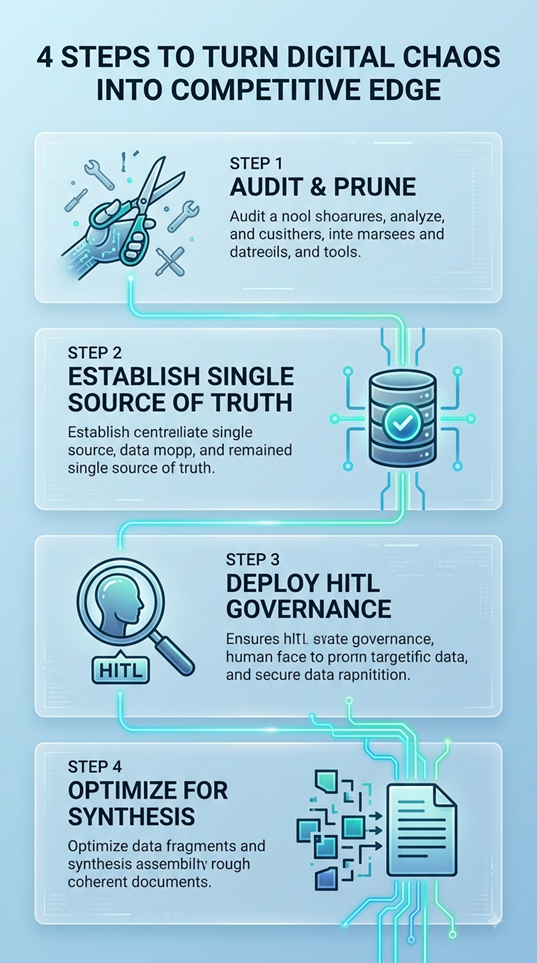
Step 1: Audit and Prune (Tech Stack Rationalization)
Start by running a strict tool audit across every team. Map out every active AI subscription, its monthly cost, and its specific operational output.
- Consolidate functions: Replace five single-use apps with one flexible platform or custom API integration.
- Eliminate redundancy: If two tools cover similar ground, keep the one that integrates cleanest with your core customer platform.
Step 2: Establish Single Sources of Truth (Data Readiness & RAG)
To deliver accurate results, AI needs context. Implement Retrieval-Augmented Generation (RAG) architectures that link language models directly to clean, internal company data.
Clean up your internal docs. Remove outdated policies, organize your brand guides, and standardise product documentation. When your underlying data is clean, hallucination risks vanish.
Step 3: Deploy Human-in-the-Loop (HITL) Governance
Never rely on automated outputs without human oversight. Set up a clear Human-in-the-Loop (HITL) process for every client-facing asset.
- Drafting: Let algorithms handle heavy research, structuring, and early drafts.
- Reviewing: Have subject-matter experts review factual accuracy, brand alignment, and tone.
- Refining: Use human expertise to add original insights, real case studies, and distinct perspective that software simply cannot replicate.
Step 4: Optimize for Synthesis, Not Just Search
Publish content formatted so AI crawlers can easily digest and quote your insights.
Use clear header hierarchies, bulleted summaries, explicit definitions, and schema markup (Article and FAQPage). When your site offers clean, reliable information, answer engines naturally treat your brand as a primary source.
Measuring the ROI of AI Simplification
Slashing tool noise delivers direct, measurable commercial returns. Track these four core metrics to assess your streamlining efforts:
- Time-to-Insight: Tracks how quickly your team turns raw inputs into market-ready assets.
- Redundant Tool Costs Saved: Calculates direct budget savings achieved by cutting unnecessary point-solution subscriptions.
- Workflow Automation Velocity: Measures task completion speed before and after consolidating your software stack.
- Generative Citation Frequency: Counts how often search engines cite your site content in automated answers.
Building Your Strategic Moat in an Automated World
Buying extra software will not give you a lasting competitive advantage—anyone with a credit card can sign up for the same apps.
Your real advantage comes from orchestration. By consolidating your stack, organizing your data, and maintaining strict human oversight, you turn confusing tech noise into a sleek operational engine. While competitors waste time troubleshooting broken tools, your streamlined workflow lets you move faster, market smarter, and deliver far better value.
Conclusion
The AI Complexity Trap holds back brands that prioritize buying software over building a coherent strategy. By trimming unnecessary tools, organizing internal data, maintaining human oversight, and formatting content for generative answer engines, you turn technical friction into a clear commercial advantage. True technological power comes from clarity, not complexity.
Frequently Asked Questions (FAQs)
What is the AI complexity trap?
The AI complexity trap occurs when an organization adopts too many disjointed software tools without a clear integration plan. This causes fragmented workflows, high subscription expenses, unreliable data, and a poor return on investment.
How does AI complexity impact business ROI?
Unchecked complexity drains budgets through duplicate software fees, lost employee productivity, and low-quality outputs. Teams spend more time managing software setups and correcting faulty results than driving core business growth.
How do you simplify an enterprise AI stack?
You can simplify an enterprise stack by auditing current subscriptions, cutting redundant single-use apps, and creating a unified workspace. Connecting your software to clean, internal data sources via RAG architecture ensures consistent, high-quality results.
What is the difference between SEO and GEO in AI strategy?
Traditional SEO targets higher search rankings by optimizing for specific keywords, while GEO (Generative Engine Optimization) structures content so AI platforms can easily summarize and cite it. GEO focuses on concise definitions, strong information density, and logical semantic formatting.
Why is Human-in-the-Loop (HITL) governance important for AI workflows?
Human-in-the-Loop governance ensures that real people review, verify, and refine automated outputs before publication. This step prevents inaccurate hallucinations, protects brand voice, and keeps content aligned with strict quality and compliance standards.