Introduction
Think about the last time you opened a support ticket or jumped onto a live chat. You didn’t type “best SaaS invoicing software 2026.” You typed something raw, specific, and frustrated: “Why isn’t my VAT tax showing up on my downloadable PDF invoice for my European client?”
For years, digital businesses treated support archives like a digital landfill—unstructured data sitting in Zendesk or Intercom, calculated purely as a cost center. But while your content team was spending thousands targeting high-volume, generic keywords, your users were dropping exact-match conversational queries directly into your customer service portal.
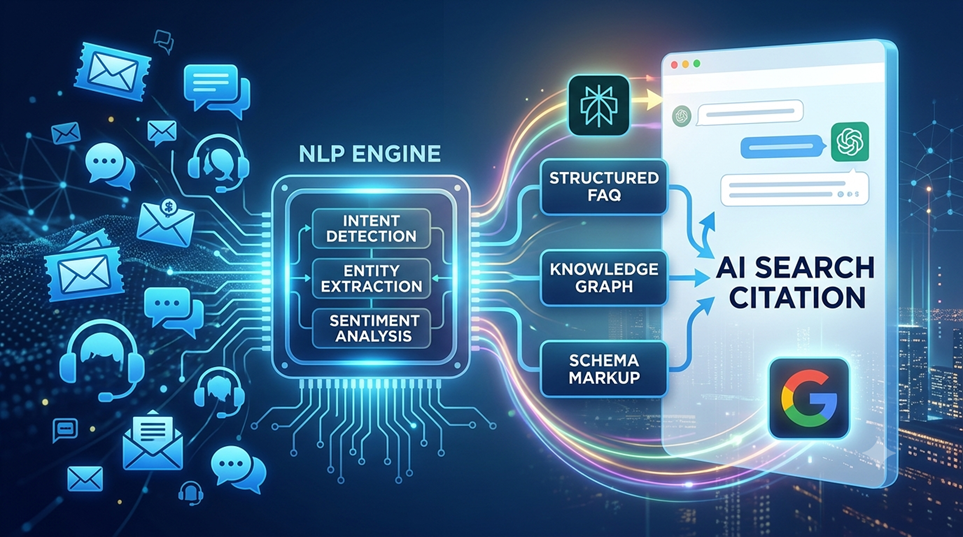
Enter the power of natural language processing in customer service. When you apply modern NLP tools to your support transcripts, you stop viewing tickets as mere operational headaches. Instead, you unlock an unedited blueprint of real-world user intent. In an era dominated by Generative Engine Optimization (GEO), where platforms like Perplexity, ChatGPT Search, and Google AI Overviews hunt for hyper-specific answers, your customer support logs are your ultimate competitive edge.
The Support Ticket Paradigm Shift: From Operational Expense to SEO Goldmine
Unfiltered Human Queries: The Rawest Form of User Intent
Traditional keyword research tools operate on historical averages. They tell you what people typed into a search bar six months ago. Customer support transcripts, on the other hand, tell you what your actual target audience is struggling with right now.
When users hit a roadblock, they drop the artificial “search syntax.” They ask full sentences, express nuanced frustrations, and mix technical terms with everyday language. That raw text is pure gold for content strategists.
Why Traditional Keyword Tools Fall Short in the Age of Generative AI
Tools like Ahrefs or Semrush are brilliant for estimating broad search volume, but they often miss the micro-intents that power AI search engines. Generative search engines don’t care about a single high-volume keyword; they parse deep context, semantic relationships, and conversational nuances. If your competitors are all writing the exact same 2,000-word “Ultimate Guide” based on the same keyword tools, they end up creating a sea of identical content. Your support logs contain the precise edge-case details that set your site apart.
Why Generative Search Engines Crave Support Log Intelligence
How Perplexity, ChatGPT Search, and Gemini Evaluate Citation Authority
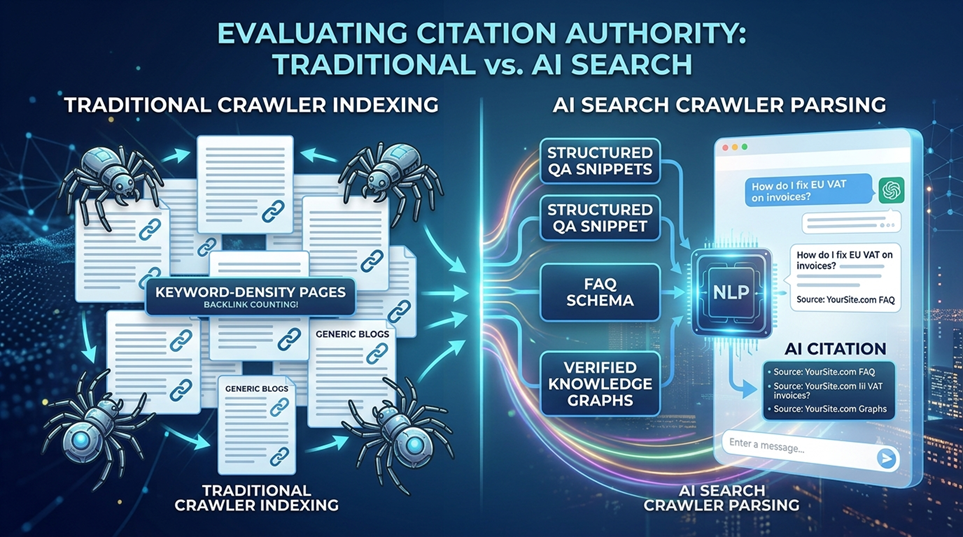
Generative search engines function fundamentally differently from classic blue-link search engines. They don’t just count backlinks; they evaluate how accurately an article resolves a complex, multi-layered prompt. When an AI crawler indexes a site, it scans for clear entity relationships, direct problem-solution pairs, and verified knowledge graphs.
Solving the Long-Tail Edge Cases That Generic Blogs Miss
When a user asks Perplexity a highly specific question, the AI won’t cite a surface-level blog post that glosses over the details. It cites the documentation, blog, or FAQ that tackles the exact edge case. Because your support tickets are essentially a massive collection of real-world edge cases, mining them allows you to publish the precise answers AI models are desperate to synthesize.
Leveraging Natural Language Processing in Customer Service: The 3-Step GEO Pipeline
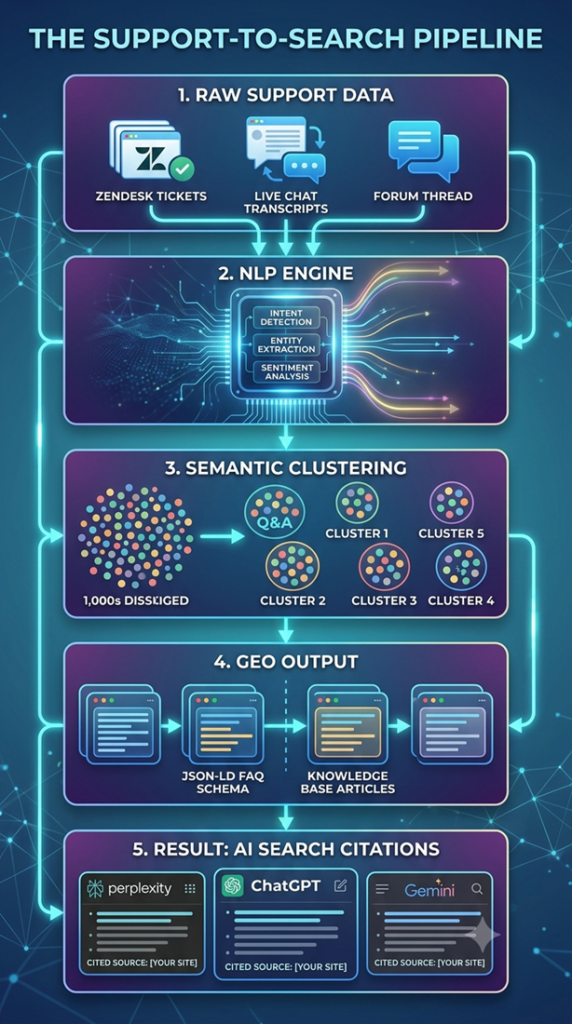
To transform messy ticket archives into high-ranking content assets, you need a systematic pipeline. Implementing natural language processing in customer service workflows allows you to automate this pipeline seamlessly.
[ Unstructured Support Logs ]
│
▼
┌──────────────────────────────┐
│ Step 1: NLP Extraction │ –> Extracts Entities, Intent & Sentiment
└───────────┬──────────────────┘
│
▼
┌──────────────────────────────┐
│ Step 2: Semantic Clustering │ –> Groups Tickets into Question Clusters
└───────────┬──────────────────┘
│
▼
┌──────────────────────────────┐
│ Step 3: GEO Deployment │ –> Generates Structured FAQ & Schema
└──────────────────────────────┘
Step 1: Intent & Entity Extraction Using NLP Algorithms
Raw support text is noisy. Modern NLP models scrub away greetings and irrelevant text to perform two critical tasks:
- Intent Extraction: What is the user trying to accomplish? (e.g., configure_tax_setting)
- Entity Extraction: What specific features, product modules, or external standards are mentioned? (e.g., VAT, PDF Export, EU Accounts)
By categorizing text this way, you turn chaos into clean, structured data points.
Step 2: Semantic Clustering and Conversational Mapping
Once entities and intents are identified, semantic clustering algorithms group thousands of individual tickets into distinct “question clusters.” Instead of seeing 500 isolated complaints about billing, your dashboard highlights a distinct pattern: 150 users this month asked why EU-specific VAT rules fail during manual invoice generation.
This isn’t just an engineering bug report—it’s an immediate, high-converting content opportunity.
Step 3: Schema Deployment and Knowledge Base Publishing for AI Crawlers
The final step is converting those high-frequency NLP clusters into structured, crawlable assets on your domain. Publish dedicated Q&A articles, update your core product pages, and wrap everything in FAQPage or HowTo JSON-LD schema markup. This structured format signals directly to LLM web crawlers that your domain holds the authoritative answer to that specific conversational query.
Real-World Breakdown: Keyword Research vs. NLP Ticket Extraction
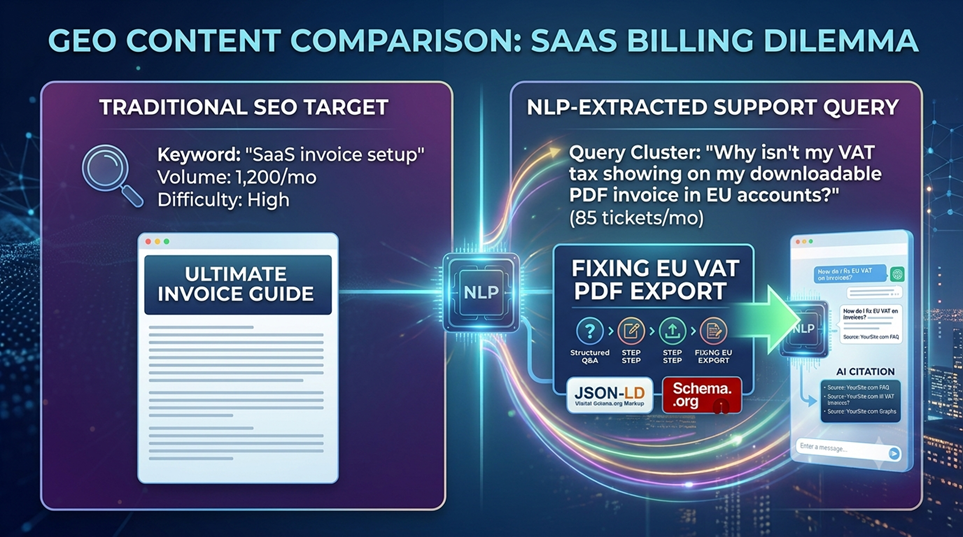
Case Study Scenario: The SaaS Billing Dilemma
Let’s see how this works in practice for a growing SaaS company handling international billing integrations.
The SEO Tool Insight vs. The Customer Log Reality
- Traditional Keyword Tool Result: The team targets “SaaS invoice setup guide” (Volume: 1,200/mo, Keyword Difficulty: High). They write a broad overview covering basic invoicing concepts.
- NLP Ticket Extraction Result: By running natural language processing in customer service logs, the team discovers 85 tickets matching this pattern: “Why isn’t my VAT tax showing on my downloadable PDF invoice in EU accounts?”
Why AI Search Engines Pick the Support-Derived Answer Every Time
When an enterprise user asks an AI assistant how to solve their European tax display issue, the broad “setup guide” gets ignored—it’s too generic. The support-derived piece, however, answers the specific query directly. The AI search engine synthesizes the detailed solution, cites your site as the primary source, and sends high-intent organic traffic straight to your product.
Actionable Implementation Roadmap for Marketing and Product Teams
Ready to turn your helpdesk into a search ranking machine? Follow this step-by-step roadmap:
Audit Your Helpdesk NLP Infrastructure
Review your current customer support software (Zendesk, Intercom, Freshdesk, Crisp). Check if native AI tagging is enabled, or integrate third-party NLP analytics tools (like Sentisum, Keatext, or custom LLM API scripts) to start categorizing ticket text automatically.
Run Semantic Clustering Prompts on Ticket Summaries
If you’re on a tight budget, export resolved ticket summaries from the last quarter into CSV format. Use an LLM script to categorize them by recurring user pain points, specific feature questions, and exact phrasing patterns.
Build a Unified Feedback Loop Between Support and Marketing
Break down the silos in your organization. Schedule a bi-weekly sync between support leads and SEO strategists. When support flags an emerging question cluster, marketing should turn it into a structured Q&A asset within days.
Publish Structured, Conversational QA Assets on Your Domain
Create an open-access Knowledge Base or Hub section on your website. Ensure every article:
- Uses the exact conversational phrasing revealed by your support NLP logs in the title and subheadings.
- Provides a direct, concise answer in the first 50 words (ideal for AI snippet extraction).
- Includes JSON-LD structured data schema to maximize crawler visibility.
Conclusion
Generative search engines have fundamentally changed how people find answers online. Static keyword research is no longer enough to win top rankings or AI search citations. By tapping into natural language processing in customer service archives, you transform your support tickets into a real-time search strategy engine. You’ll answer the exact questions your market is asking, position your site as a trusted authority for generative crawlers, and drive organic growth by simply listening to your customers.
Frequently Asked Questions (FAQs)
How does natural language processing in customer service improve website SEO?
It helps you identify real, conversational long-tail queries and pain points directly from users. By turning these insights into structured content, you create pages that match the precise natural-language prompts used in AI search engines, improving overall visibility.
What is the main difference between traditional SEO and Generative Engine Optimization (GEO)?
Traditional SEO focuses primarily on optimizing for specific keyword volumes, meta tags, and backlink authority to rank on search engine results pages. GEO optimizes content for AI engines (like Perplexity and ChatGPT) by providing detailed, structured, conversational answers that AI models can easily cite as authoritative sources.
Do I need advanced coding skills to analyze support transcripts for SEO?
Not necessarily. While custom Python scripts offer high flexibility, many modern helpdesk platforms come with built-in AI analytics tools. You can also export ticket summaries to CSV and utilize LLM analysis prompts to cluster topics without writing code.
How frequently should support logs be mined for content updates?
A monthly or quarterly audit is ideal for most growing businesses. However, after major product updates or feature rollouts, auditing support logs weekly helps you quickly address new user friction points before competitors do.
Will publishing support-derived content risk exposing sensitive customer data?
No, provided you sanitize your data first. The NLP analysis pipeline strips away personally identifiable information (PII) such as names, emails, and account numbers, leaving only generic intent patterns, questions, and entity relationships to inform your content strategy.