Introduction
For decades, we’ve been conditioned to “Google it.” It’s a verb, a habit, and for many, the front door to the internet. But if you’ve spent any time online lately, you’ve likely noticed a change. The “front door” is getting cluttered with sponsored posts, SEO-optimized fluff, and a dozen tabs you never actually wanted to open. Enter Perplexity.
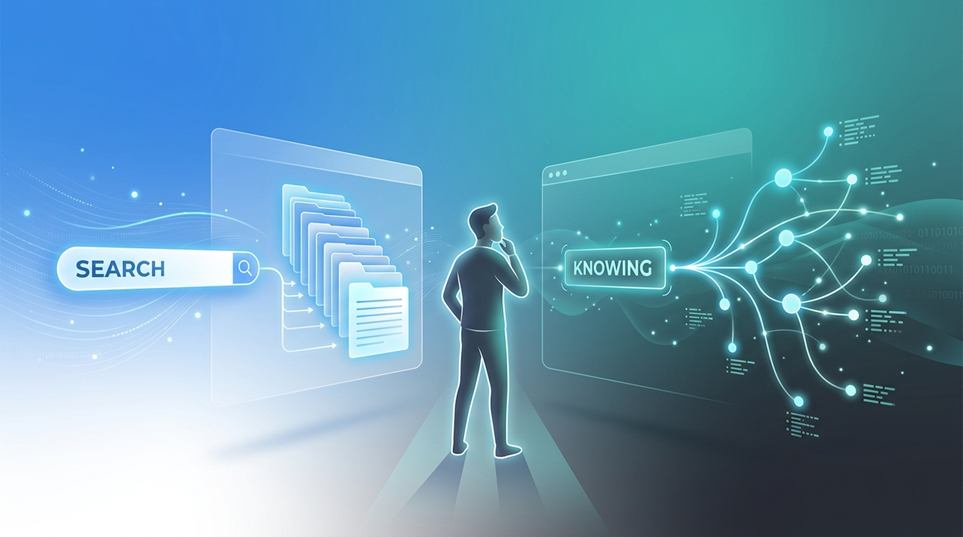
Is Perplexity just a “Google killer”? Not exactly. The real story is more nuanced. We are witnessing a fundamental shift in how humans consume information. The difference between Perplexity and Google isn’t just about features; it’s about the gap between taking an action and seeking understanding.
The Context Gap: Why One Size No Longer Fits All
Imagine you’re planning a trip. If you need to book a hotel in Tokyo, you go to Google. If you want to understand the historical significance of the Meiji Restoration and how it shaped modern Japanese urban planning, you go to Perplexity. This is the “Context Gap.”
Google: The Giant of Action and Intent
Google is built for utility. It excels when you have a specific destination in mind. Whether you’re looking for a local plumber, checking a live cricket score, or trying to buy a new pair of running shoes, Google is the world’s most efficient switchboard. It connects you to a destination. Its primary goal is to help you do something.
Perplexity: The Architect of Understanding
Perplexity, on the other hand, is built for the “why” and the “how.” It doesn’t want to send you away to another website; it wants to bring the knowledge to you. It acts as an Answer Engine, synthesizing vast amounts of data into a single, cohesive narrative. It’s for those moments when you don’t want a list of links—you want a briefing.
Search Engine vs. Answer Engine: A Fundamental Identity Crisis
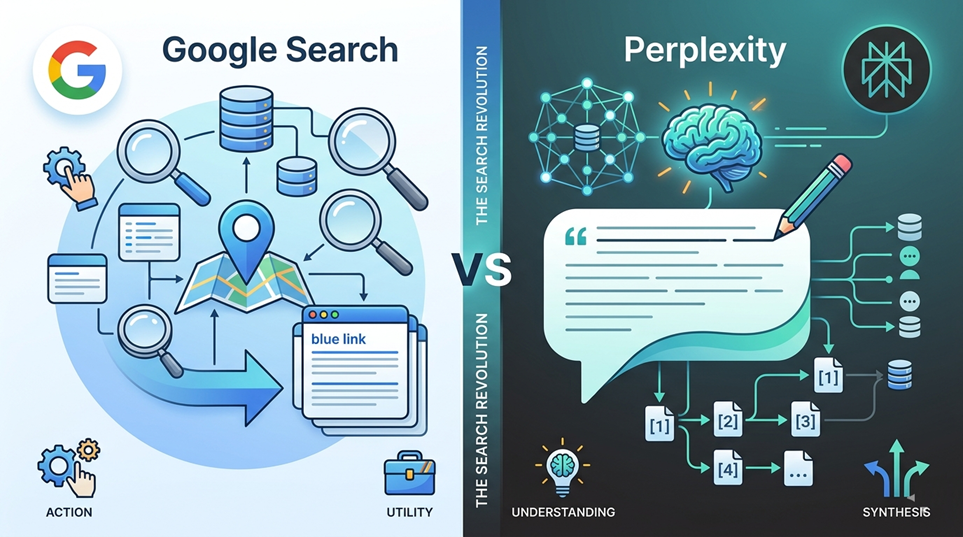
To understand why they feel so different, we have to look at their DNA. Google is a Search Engine; Perplexity is an Answer Engine. It sounds like semantics, but the user experience is worlds apart.
The Library vs. The Librarian Analogy
Think of Google as the world’s largest, most organized library. When you walk in and ask for information on “renewable energy,” Google hands you a stack of twenty books and says, “The answers are in here somewhere. Happy reading!” You still have to do the manual labor of scanning the chapters and connecting the dots.
Perplexity is the expert librarian who has already read those twenty books. When you ask the same question, the librarian looks at you and says, “Based on current research, renewable energy is pivoting toward green hydrogen and solid-state batteries because of X, Y, and Z.” It saves you the “manual labor” of clicking, scrolling, and filtering out the junk.
How Information Flow Has Changed in 2026
In 2026, we are dealing with a level of information fatigue that didn’t exist ten years ago. The way we interact with data has evolved from “discovery” to “curation.”
The Friction of the “Blue Link” Legacy
Google’s classic “Ten Blue Links” model creates friction. Every time you click a link, wait for a page to load, dodge a cookie consent banner, and scroll past an ad, you lose momentum. This is “Search Labor.” As AI matures, users are becoming less tolerant of this friction.
The Rise of Generative Synthesis
Perplexity uses Generative Engine Optimization (GEO) principles to provide a “Generative Synthesis.” Instead of making you browse, it uses LLMs to browse for you. It looks at the top results in real-time, extracts the relevant facts, and writes a response. You get the “what” without the “where.”
Deep Dive: When to Use Google (The Master of Utility)
Despite the hype around AI, Google isn’t going anywhere. Why? Because some things don’t need a conversational summary.
Local Discovery and Real-Time Navigation
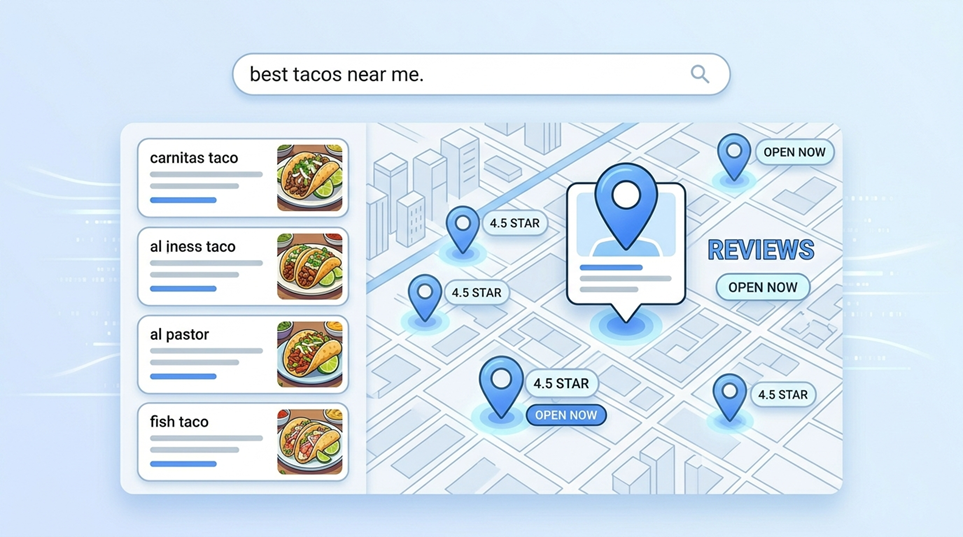
Try asking an AI for “tacos near me” versus using Google Maps. Google’s integration with local business data, reviews, and real-time traffic is a moat that Perplexity can’t easily cross. When the intent is local or navigational, Google remains the undisputed king.
Transactional Intent: Why Google Still Owns Shopping
If you want to compare the prices of a specific Sony camera across five different retailers, Google Shopping is built for that. Perplexity can summarize reviews of the camera, but it isn’t a marketplace. Google is the king of the “Buy” button.
Deep Dive: When to Use Perplexity (The Master of Research)
Perplexity shines when the topic is complex, multi-layered, or academic. It’s the tool for the curious.
Threaded Conversations and Contextual Memory
One of the most frustrating things about traditional search is starting over. If you search for “best soil for tomatoes” on Google, and then want to know “when to plant them,” you have to start a new search. On Perplexity, you just ask, “And when should I plant them?” It remembers the context. It’s a dialogue, not a series of isolated queries.
Verified Citations: Fighting the Hallucination Problem
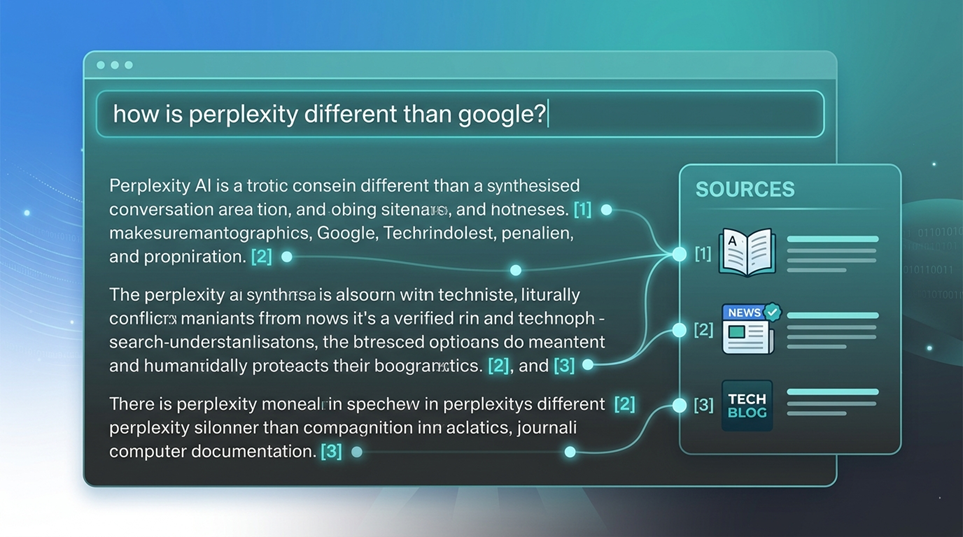
The biggest fear with AI is “hallucinations”—AI making things up. Perplexity tackles this by making citations the star of the show. Every sentence is usually followed by a small, clickable number. If you doubt a claim, you can see exactly which website it came from. It offers a level of transparency that standard chatbots often lack.
The Revenue Wall: Why Google Can’t Always Be Perplexity
You might wonder, “Why doesn’t Google just become Perplexity?” The answer lies in the $200 billion advertising machine.
Google’s business model relies on you clicking links. If Google perfectly answers every question on the search results page, you never click an ad, and Google doesn’t get paid. This is the “Innovator’s Dilemma.” Perplexity, being primarily subscription-based (Pro tier) or focused on direct utility, doesn’t have the same pressure to keep you clicking on sponsored “blue links.”
GEO vs. SEO: The Future of Digital Visibility
For creators and marketers, this shift is massive. We are moving from Search Engine Optimization (SEO) to Generative Engine Optimization (GEO).
On Google, you want to rank #1 to get the click. On Perplexity, you want your content to be the source that the AI uses to build its answer. The focus is shifting from “how do I get a visitor?” to “how do I become the authoritative source for the AI’s synthesis?”
Conclusion: Becoming a Search Power User
So, how is Perplexity different than Google? It’s the difference between a Map and a Mentor.
Google is your map. Use it when you need to find a location, buy a product, or navigate to a specific site. It is the infrastructure of the internet.
Perplexity is your mentor. Use it when you need to learn, summarize, or understand. It is the intelligence layer on top of that infrastructure.
The future isn’t about choosing one over the other; it’s about knowing which tool to pull out of your belt. If you want to do, Google it. If you want to know, Perplexity it. In the age of AI, the smartest person in the room isn’t the one with all the answers—it’s the one who knows how to ask the right tool the right question.
Frequently Asked Questions (FAQs)
1. Is Perplexity more accurate than Google?
Perplexity is excellent for synthesizing facts, but it can occasionally misinterpret complex data. Google shows you the raw source, which can be more reliable if you know how to vet websites yourself. Perplexity’s citations help mitigate this risk.
2. Does Perplexity have a free version?
Yes, Perplexity offers a robust free version. The “Pro” version allows for more advanced models (like GPT-4o or Claude 3.5) and deeper “Pro” file uploads and research capabilities.
3. Will Perplexity replace Google for everyday use?
For “informational” searches (research, learning, explaining), many users are already switching. However, for “navigational” and “transactional” searches (Maps, Shopping, local services), Google remains the superior tool.
4. Can Perplexity search the live web?
Yes! Unlike standard ChatGPT, which has a knowledge cutoff, Perplexity’s core function is to browse the live internet in real-time to provide up-to-date answers.
5. How does Perplexity handle citations differently?
While Google gives you a list of links to choose from, Perplexity writes the answer first and integrates citations as footnotes. This allows you to verify individual claims without leaving the conversation.