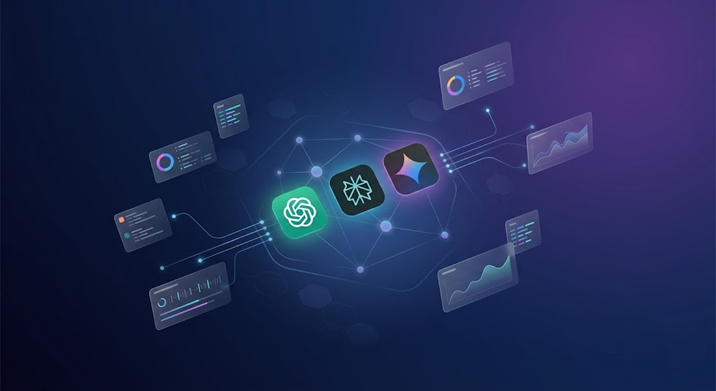
What are the best AEO platforms in 2026?
The best Answer Engine Optimization tools include Listable Labs for all-in-one practitioner workflows, Profound for enterprise analytics, and Writesonic for direct, real-time content optimization.
The Death of the Rank Tracker: Why the Traditional SEO Dashboard is Broken
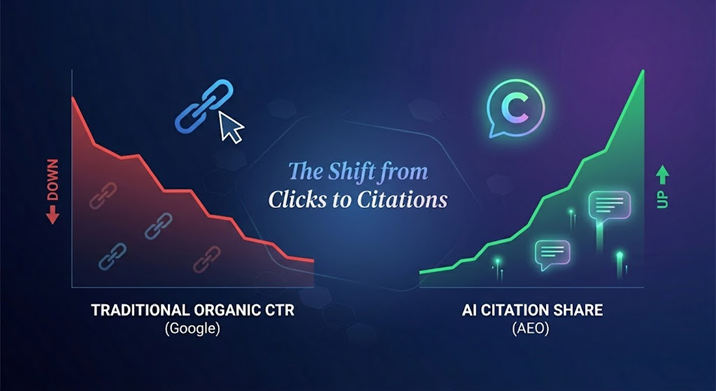
Remember when tracking SEO success meant opening up a dashboard and cheering because your core keyword hit position #3 on Google? Those days feel like ancient history. In 2026, the traditional SEO dashboard isn’t just outdated—it is functionally blind.
The Massive Shift from Clicks to Citations
When users search today, they aren’t scanning a list of ten blue links. They are reading a fluid, customized paragraph generated by an AI assistant. If your brand isn’t woven into that response as an active, clickable citation, you don’t exist to that user. Clicks are plummeting because search engines are solving problems natively on the page. The currency of modern web visibility has fundamentally evolved from raw organic impressions to high-value engine citations.
Understanding Share of Voice (SoV) vs. Geometric Rankings
Traditional tracking software tells you where a URL ranks in a static index. But large language models (LLMs) don’t have a static index. They synthesize real-time data dynamically. Because of this, marketing teams have switched their main KPI to Share of Voice (SoV) and Citation Share. If ChatGPT generates ten different product recommendations across ten variations of a prompt, how many of those summaries prominently feature your brand? That is the macro-metric that matters now.
The Core Conflict: Observability vs. Actionability in 2026
As the software market races to serve modern search teams, a massive divide has formed. It’s the battle between Observability and Actionability.
Most baseline listicles scrape generic software landing pages, telling you that a platform “tracks brand mentions across LLMs.” Let’s be completely honest: simply knowing that your brand visibility dropped 12% inside Perplexity this week is utterly useless if the software leaves you staring at a blank screen wondering why.
True optimization requires more than just tracking lines on a graph. The best tools in 2026 don’t just observe the disaster—they give you the exact diagnostic steps to fix your content gaps so you can win back your visibility.
The Best Answer Engine Optimization Platforms of 2026
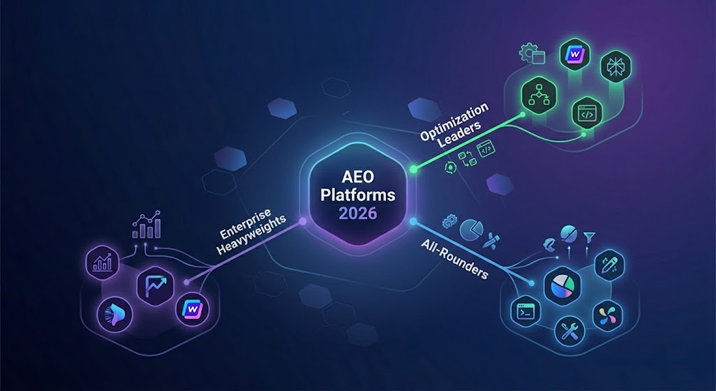
To help you cut through the marketing noise, we’ve broken down the leading tools by user profile, specialized functionality, and practical use cases.
The Enterprise Heavyweights: Deep Analytics & ROI Attribution
These systems are custom-built for large corporations, data-heavy teams, and CMOs who need to prove the exact monetary value of their optimization spend to board members.
Profound: Tying AI Citations to Revenue
Profound has cemented its spot at the top of the enterprise market for one critical reason: it solves the attribution problem. It doesn’t just show you that your enterprise B2B software was cited inside ChatGPT Search; it bridges the data gap to tie that specific citation directly to your Google Analytics conversions and pipeline metrics. If you need to know exactly how much revenue an absolute increase in Perplexity footprint generates, Profound is the gold standard.
Goodie / AthenaHQ: Autonomous Narrative Tracking
Goodie (frequently operating alongside the AthenaHQ engine) approaches optimization from a corporate reputation angle. It continuously tracks brand sentiment and narrative trajectories across complex corporate entities. If a major model begins hallucinating or shifting its tone from positive to neutral when describing your security compliance protocols, AthenaHQ flags the anomaly instantly and isolates the source material causing the drift.
The Optimization & Content Execution Leaders
If you are a practitioner who needs to write, update, and deploy pages immediately based on shifting engine data, these platforms are designed for your day-to-day workflow.
Writesonic (GEO Platform): In-App Content Healing
Writesonic has successfully shifted from a standard AI writing assistant into a powerhouse Generative Engine Optimization (GEO) platform. It doesn’t just show you where your competitors are stealing your citation real estate—it features a built-in content healing workspace. It flags the missing context on your page and generates the precise structural paragraphs, tables, or data markers needed to capture the citation, allowing you to deploy updates directly to your CMS.
AirOps & Quattr: Programmatic Workflows at Scale
AirOps and Quattr are built for massive sites and e-commerce platforms with thousands of landing pages. These platforms use programmatic workflows to dynamically analyze content gaps across entire product catalogs. If a specific category of your online store loses visibility inside Google’s AI Overviews, these tools programmatically adjust structural content layers and schema configurations to align with the model’s new extraction parameters.
The Best All-Rounders & Mid-Market Trackers
These platforms offer the perfect balance of deep tracking capabilities, highly actionable insight interfaces, and flexible pricing structures for agencies and growing brands.
Listable Labs: The Unified Practitioner Workspace
Listable Labs is arguably the premier workspace for agile digital agencies and modern marketing teams. It unifies competitive benchmarking, multi-LLM tracking, and concrete action plans into a single clean UI. Instead of overwhelming you with raw engineering telemetry, it translates complex vector-distance shifts into a straightforward task list: “Add a comparison table to this URL to regain your Perplexity citation.”
Semrush AI Optimization Toolkit: The Familiar Add-on Play
For teams already deeply embedded within the traditional Semrush ecosystem, their specialized AI Optimization Toolkit (now fully integrated into Semrush One) offers a low-friction entry point. It blends your existing keyword research data with incoming AI Overview share metrics, making it incredibly easy to track how your standard organic positioning relates to your generative visibility.
AIClicks & Otterly AI: Fast, Budget-Friendly Prompt Monitoring
If you run an early-stage startup, a boutique local brand, or a lean marketing team, enterprise price tags are out of the question. Tools like AIClicks and Otterly AI offer hyper-accessible prompt monitoring setups starting between $29 and $39 a month. They allow you to lock in a specific core set of high-value buyer prompts and receive clean alerts the second your brand drops out of the top recommendation answers.
2026 AEO Platform Comparison Matrix
| Platform Name | Best Fit For | Core LLMs Covered | Starting Price |
| Profound | Enterprise CMOs & Data Analytics Teams | ChatGPT, Perplexity, Gemini, Claude | Custom Enterprise |
| Writesonic (GEO) | Content Teams & SEO Agencys | ChatGPT, Perplexity, Google AIO | $99 / month |
| Listable Labs | Mid-Market Brands & In-house Teams | ChatGPT, Perplexity, Gemini | $149 / month |
| Semrush AI Toolkit | Existing Semrush Users | Google AI Overviews, ChatGPT | Add-on Suite |
| AIClicks / Otterly | Startups & Boutique Agencies | ChatGPT, Perplexity | $29 / month |
The “Information Gain” Framework: How to Evaluate Your Core Tech Stack
Choosing your software suite shouldn’t be based on shiny user interfaces. You need to look under the hood to ensure the tool actually collects accurate data.
UI-Level Scraping vs. Flat API Data Tracking
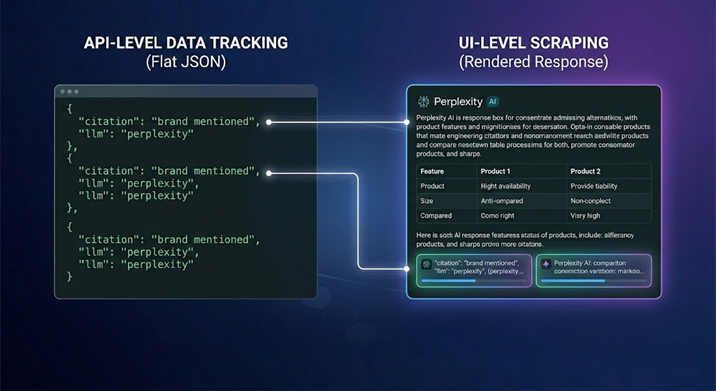
This is the hidden flaw most software sales reps won’t tell you about. Many cheap tracking tools pull data exclusively through flat API calls. However, API results completely strip out the real-world formatting—such as markdown tables, custom bullet cards, maps, or interactive buttons—that a human user actually sees on screen. Ensure your chosen tool utilizes advanced UI-level rendering so you see exactly what your customers see.
Model Drifts and the Need for Real-Time Data Refresh Rates
Traditional search indices update predictably. AI models, on the other hand, change completely whenever a new weights patch or fine-tuning layer is deployed. A keyword tracking report that updates once every two weeks is fundamentally useless. Your platform must offer high-frequency tracking loops that catch sudden system updates before they skew your monthly lead flow.
Brand Safety: Tracking Hallucinations and Misinformation
What happens when an LLM recommends your software product but falsely claims you don’t support a feature that you actually excel at? Or worse, what if it lists an incorrect support phone number? Your platform must feature real-time misinformation alerts that actively flag inaccurate claims being programmatically served to potential buyers.
| Traditional SEO Is Blind (Misses Conversational Blending) | ||
| Pure Observability • Alerts you to drops • Monitors raw citations • Flat data lines | Active Actionability • Diagnoses content gaps • Generates data • Direct CMS execution tables |
Turning Software Metrics into Actual Organic Growth
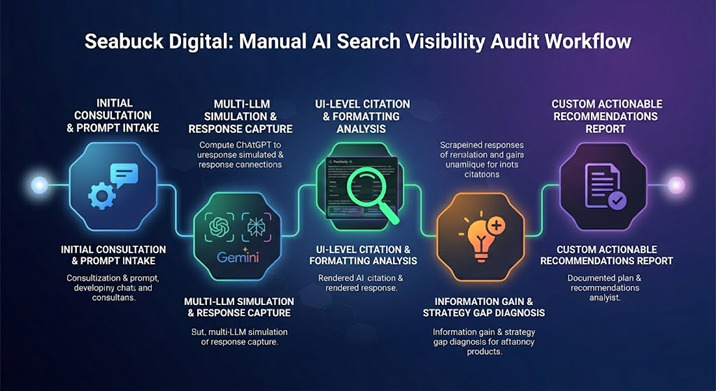
At the end of the day, software is only as good as the overarching digital strategy driving it. You can purchase the most expensive enterprise dashboard on the market, but if your content lacks true Information Gain—unique statistics, proprietary industry data, or lived case studies—no tool will save your visibility. Real optimization requires manual expertise, cultural context, and an understanding of how semantic search systems operate.
If you want to stop guessing and uncover exactly how the world’s leading AI engines see your business right now, let our team run a specialized, manual analysis for you. Reach out to get a custom, comprehensive AI Search Visibility Audit handled entirely by our expert strategy team at Seabuck Digital.
Frequently Asked Questions (FAQs)
Q1: What is the main difference between traditional SEO software and an AEO platform?
Traditional SEO software measures your URL’s physical position in static search results. An AEO platform tracks your brand’s Share of Voice, conversational citation frequency, and narrative presence within AI synthesizers like ChatGPT, Perplexity, and Gemini.
Q2: Why are some tools reporting “zero volume” for keywords that drive actual AI traffic?
Traditional keyword research tools rely on historic Google autocompletes and click streams. Conversational AI queries are much longer, highly unique, and intent-driven, which causes standard database estimators to heavily underreport their true traffic potential.
Q3: Can an AEO platform automatically fix my website content?
Certain advanced optimization platforms like Writesonic (GEO) or programmatic suites like AirOps provide inline content suggestions and generation panels, allowing you to quickly patch context gaps and push updates straight to your live site via CMS integrations.
Q4: Is UI-level scraping better than tracking via developer APIs?
Yes. Developer APIs often return raw, unformatted text strings. UI-level scraping captures the actual visual response layout, ensuring you see exactly how your brand citations, tables, or product cards are presented to everyday users.
Q5: How often do AI search engine rankings shift compared to regular Google search?
AI search engines fluctuate far more dynamically. Because they synthesize content based on real-time data retrievals, user prompt context, and frequent model updates, your citation footprints can shift daily rather than weekly.