Introduction
Imagine walking into an exclusive networking event where a trusted advisor introduces only three people in the entire room to a room full of ready-to-buy executives. Everyone else? Completely invisible.
That is exactly what happens every single second inside Perplexity AI.
If you are still relying solely on traditional search engine optimization, you are fighting for ten blue links on a crowded results page. Meanwhile, millions of high-intent buyers have quietly shifted their research habits to answer engines. Learning how to get cited in Perplexity AI is no longer an experimental side project for tech nerds—it is a survival skill for modern brands, agencies, and SaaS founders.
In this playbook, we will pull back the curtain on Perplexity’s real-time retrieval mechanics and give you a step-by-step technical and off-page roadmap to claim those coveted footnote spots.
Why Perplexity AI Citations Are the New High-Intent Traffic Goldmine
Users do not open Perplexity to mindlessly browse. They open it with complex, multi-layered questions right before making a purchasing or strategic decision. When Perplexity answers them, it backs up every claim with clickable inline footnotes.
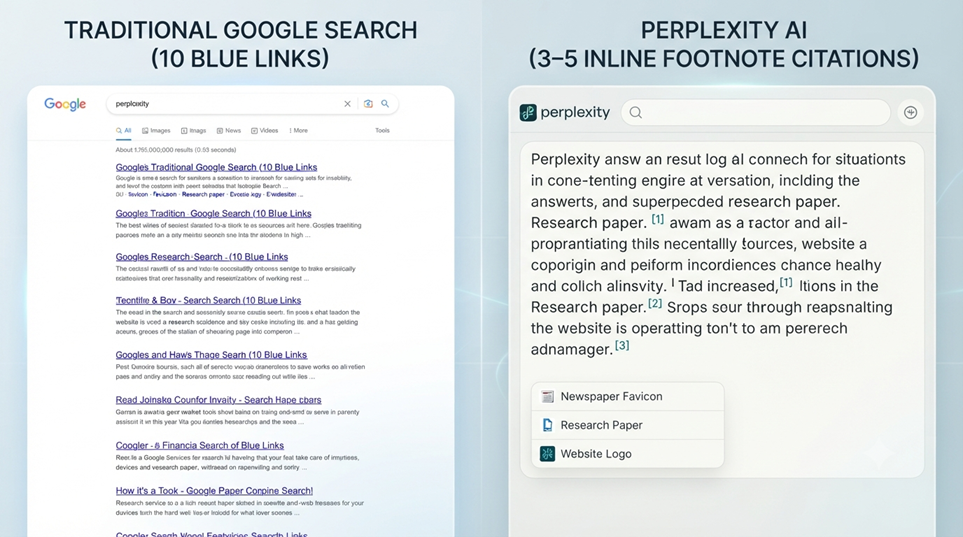
The Scarcity Game: 3 to 5 Footnotes vs. 10 Blue Links
Think about traditional Google search as a sprawling department store aisle. Even if you sit in position six or seven, a curious shopper might still scroll down and click your link.
Perplexity operates like a strict concierge. For any given query, its engine might scan hundreds of web pages behind the scenes, yet it typically surfaces only 3 to 5 primary footnote citations directly in the response. That means citation real estate is drastically scarcer than traditional organic rankings. Either you make the final cut as a verified source, or your brand does not exist in that conversation.
The Ad-Free Reality of 2026: Why Organic Authority Is Your Only Ticket In
If you were hoping to throw ad spend at the problem, those doors are locked. After testing sponsored follow-up questions in late 2024 and 2025, Perplexity officially phased out its advertising program in February 2026. Company leadership doubled down on user trust and subscription revenue, eliminating paid placements altogether.
What does this mean for your marketing strategy? You cannot buy your way into a Perplexity answer. Every single citation is earned purely through technical accessibility, structured content clarity, and third-party authority.
How Perplexity AI Actually Retrieves and Selects Its Sources
Before you tweak a single headline, you need to understand how the machine thinks. Perplexity is not a static chatbot guessing from three-year-old training data. It is a live, retrieval-augmented answer engine.
Inside the Two-Step Retrieval Pipeline and Query Fan-Out
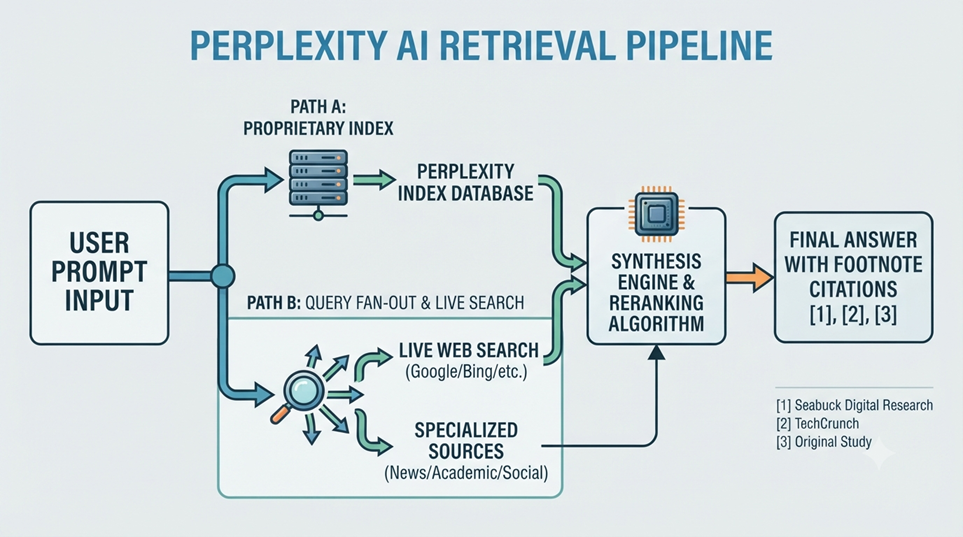
When someone types a prompt into Perplexity, the system triggers a rapid two-step retrieval pipeline:
- Proprietary Index Lookup: First, it queries its own massive web index, which is continuously built and refreshed by its dedicated crawler, PerplexityBot.
- Live Web Search & Query Fan-Out: Simultaneously, Perplexity breaks a complex user prompt into multiple smaller sub-queries—a process known as query fan-out—and runs real-time web searches across those angles.
It then reads the top-retrieved passages, cross-checks facts across multiple domains, synthesizes a cohesive answer, and attaches numbered citations to the exact sources that supplied the verifiable facts.
Google SEO vs. Perplexity Optimization: A Side-by-Side Comparison
While good SEO builds your foundation, optimizing for Generative Engine Optimization (GEO) requires shifting how you package information.
| Ranking & Visibility Factor | Traditional Google SEO | Perplexity AI Optimization (GEO) |
| Primary Output | 10+ blue links per search page | Synthesized answer with 3–5 inline footnotes |
| Unit of Evaluation | Full web page / URL authority | Individual paragraphs, tables, and data points |
| Paid Placement Options | Google Ads & AI Mode paid slots | None (ad-free organic citations only) |
| Freshness Sensitivity | Moderate (varies by query intent) | Extremely high (heavily favors recent timestamps) |
| Off-Page Trust Signals | Backlink anchor text & domain rating | Co-citations, editorial mentions, Reddit & YouTube |
Step 1: Master Technical Accessibility and Crawler Hygiene
You can write the most insightful guide on the internet, but if Perplexity’s bots hit a digital brick wall at your server door, you will never get cited. Think of technical hygiene as unlocking the front door before inviting guests inside.
Unblock PerplexityBot in Your Robots.txt and CDN Firewall
Many website owners panicked during the early AI boom and pasted generic bot-blocking snippets into their robots.txt files. Unfortunately, blocking all AI bots indiscriminately blinds Perplexity to your content.
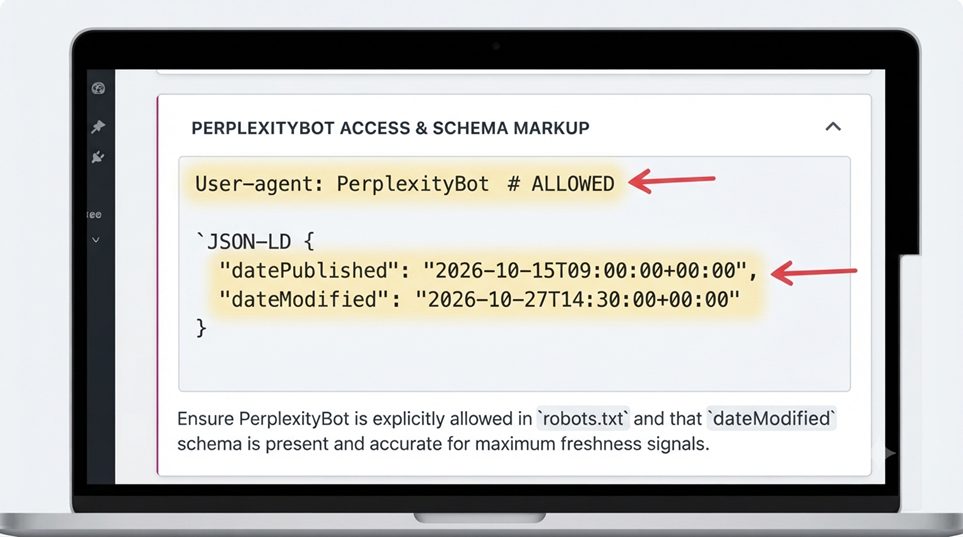
Open your robots.txt file today and ensure you explicitly allow PerplexityBot:
Plaintext
User-agent: PerplexityBot
Allow: /
Do not stop at robots.txt. Check your Cloudflare, Akamai, or hosting Web Application Firewall (WAF) settings. Aggressive bot-fight modes frequently throttle or block legitimate search crawlers even when your robots.txt welcomes them.
Switch to Server-Side Rendering (SSR) for Clean HTML Delivery
AI crawlers operate on tight compute budgets and strict timeouts. If your website relies heavily on client-side JavaScript frameworks to inject body copy after the page loads, PerplexityBot may see an empty shell and move on.
Ensure your core articles, comparison tables, and statistics are rendered server-side (SSR) or statically generated so they appear immediately inside the raw HTML source code.
Synchronize Freshness Signals and JSON-LD Schema
Perplexity is obsessed with recency. When comparing two competing articles with similar facts, its reranking algorithm consistently favors the fresher source.
- Align Your Dates: Make sure the visible “Last Updated” date on your page matches the dateModified property inside your Article JSON-LD schema.
- Keep Sitemaps Clean: Automatically ping your XML sitemap whenever you make meaningful updates to core guides, and strip out thin, outdated pages that dilute your site quality.
Step 2: Engineer Your Content for Paragraph-Level Extraction
Google ranks pages; Perplexity cites passages. When PerplexityBot scans your article, it breaks your text into semantic chunks. Your job is to make those chunks effortless for an LLM to lift, verify, and quote.
Use Answer-First Formatting for Every Question Heading
Stop burying your main point beneath three paragraphs of fluffy storytelling. Instead, structure your H2 and H3 subheadings as the exact natural-language questions your buyers type into Perplexity.
Immediately below each heading, write a self-contained, 40-to-60-word direct answer in plain, declarative language. Treat every section like a mini-encyclopedia entry. Once you deliver that crisp summary, expand into nuance, examples, and step-by-step instructions.
Prioritize Information Gain Over Derivative Fluff
If your blog post merely rephrases the top five results already sitting on Google, Perplexity has zero reason to cite you. Large language models actively filter out redundant consensus copy.
Inject genuine Information Gain into every article:
- Publish proprietary survey data, internal case study metrics, or dated benchmark tests.
- Build clean HTML comparison tables (just like the one earlier in this guide) that contrast tools, pricing, or methodologies side by side.
- Include named expert commentary or specific step-by-step workflows that cannot be found elsewhere.
Build Tight Internal Topical Clusters
One isolated blog post rarely convinces an answer engine that you are an industry authority. Connect a comprehensive pillar guide to 5–8 supporting deep-dive articles using descriptive internal anchor text. When Perplexity crawls those interconnected links, it maps your domain as a cohesive entity hub rather than a random content mill.
Step 3: Build Off-Page Authority and Strategic Co-Citations
Here is the truth most on-page SEO checklists conveniently skip: you cannot optimize your way into Perplexity solely on your own website.
Because Perplexity’s primary mission is delivering trustworthy, objective answers, it leans heavily on third-party corroboration. If reputable external websites, industry roundups, and authentic user communities talk about your brand, Perplexity treats that consensus as proof of credibility.
Reverse-Engineer the Exact Domains Perplexity Already Trusts
Want a shortcut to instant Perplexity visibility? Stop guessing which websites carry weight and let Perplexity tell you directly.
- Open Perplexity and run 10 to 15 high-intent prompts your ideal customers ask (for example, “best B2B link building agencies for SaaS” or “top GEO optimization tools”).
- Open every footnote link cited in those answers and log the domains in a spreadsheet.
- Look for patterns. You will quickly notice specific industry publications, review portals, and curated listicles appearing over and over again.
Once you have that hit list, launch targeted outreach and digital PR campaigns to get your brand featured, quoted, or reviewed on those exact third-party URLs. When you earn a mention on a domain Perplexity already trusts, you inherit its citation momentum immediately.
Expand Your Multi-Format Footprint on Reddit and YouTube
Unlike traditional search engines that historically favored corporate blogs, Perplexity pulls heavily from real human conversations and video content. Industry data from late 2026 shows that user-generated platforms—led by Reddit and YouTube—account for nearly 39% of top-cited domain shares across AI answer engines.
- YouTube Transcripts: Publish focused, educational YouTube videos answering your niche’s toughest questions. Perplexity indexes YouTube transcripts rapidly and frequently embeds or cites video segments directly in answers.
- Authentic Reddit Participation: Participate genuinely in relevant industry subreddits. Never spam links—instead, offer helpful, transparent breakdowns that naturally mention your brand’s methodology when relevant.
Maintain Google Page-One Alignment for Long-Tail Queries
Do not abandon classic search fundamentals. Because Perplexity’s live web search layer cross-references top-performing web results during query fan-out, ranking on Page One of Google for specific long-tail questions remains one of the strongest predictors of Perplexity citation overlap.
Want your brand featured on the exact high-authority publications Perplexity already trusts? On-page formatting only takes you halfway. Explore Seabuck Digital’s Editorial Link Building & Digital PR campaigns to secure authoritative brand mentions and third-party placements that turn your business into an undeniable AI citation magnet.
Step 4: Measure Your Perplexity Visibility and Referral ROI
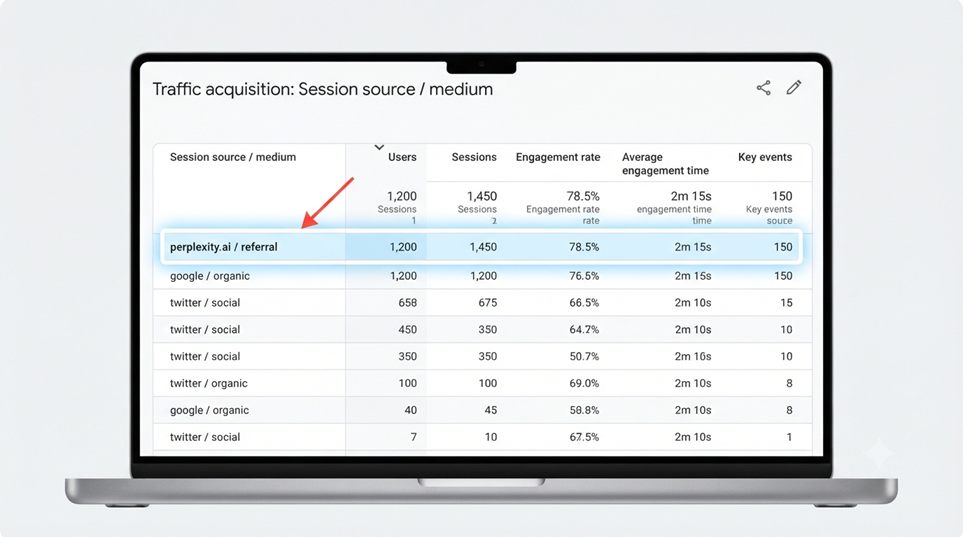
You cannot improve what you refuse to track. Traditional rank trackers will not tell you whether you are winning inside answer engines, so you need a lightweight analytics workflow.
How to Isolate Perplexity Referral Traffic in GA4
Clicks from Perplexity behave very differently from Google clicks. While total session volume may be smaller, visitors who click a footnote citation have already read the AI’s summary and vetted your credibility—meaning they convert at a dramatically higher rate.
To track them in Google Analytics 4:
- Navigate to Reports > Acquisition > Traffic acquisition.
- Change the primary dimension to Session source / medium.
- Filter for perplexity.ai / referral.
- Compare Engagement rate, Average engagement time, and Key event (conversion) rate against your standard organic search baseline.
Running Monthly Prompt-Tracking Audits
Once a month, run a standardized list of 20 core commercial and informational prompts in Perplexity (using an incognito window or clean profile to minimize personalization bias). Record three simple metrics:
- Citation Share: Percentage of prompts where your domain appears in the footnotes.
- Brand Mention Rate: Percentage of prompts where your brand name is mentioned in the text, even without a direct link.
- Competitor Displacement: Which rival brands are appearing in the prompts you missed, and which third-party articles put them there.
Conclusion
Getting cited in Perplexity AI comes down to a simple shift in mindset: stop writing to trick an algorithm into ranking a URL, and start publishing verifiable, structured expertise that an AI researcher can confidently quote. When you pair clean technical access (PerplexityBot permissions and fast HTML) with answer-first formatting and real-world off-page authority, you turn Perplexity’s strict 3-to-5 footnote limit into your highest-converting acquisition channel. Start by auditing your top five money pages today, tightening their direct answers, and building the third-party brand mentions that prove you belong in the conversation.
Frequently Asked Questions (FAQs)
Does PerplexityBot use my website content to train AI models?
No, Perplexity states that PerplexityBot is strictly used to index web pages so its search engine can surface and cite them in live answers. Because Perplexity relies on third-party foundation models rather than pre-training its own base models from scratch, allowing PerplexityBot does not feed your proprietary content into model training datasets.
How long does it take to get cited in Perplexity after updating a page?
Because Perplexity combines its index with real-time web retrieval, updates can show up in citations within 24 to 72 hours—much faster than traditional Google ranking cycles. Updating your dateModified schema, refreshing statistics, and resubmitting your XML sitemap speeds up discovery significantly.
Can I pay for sponsored placements or ads inside Perplexity AI?
No, you cannot buy ad placements on Perplexity. Perplexity discontinued its experimental ad program in February 2026 to preserve user trust and focus on subscriptions. Organic citations earned through content quality, technical hygiene, and third-party authority are the only way to appear in its answers.
Why does Perplexity cite Reddit threads and YouTube videos so often?
Perplexity’s retrieval engine prioritizes first-hand human experience, product comparisons, and authentic consensus when answering commercial or troubleshooting queries. Reddit discussions and timestamped YouTube transcripts provide dense, conversational proof that often cuts through overly polished corporate marketing copy.
Do traditional backlinks still matter for Perplexity citations?
Yes, though they work both directly and indirectly. High-authority editorial backlinks boost your Page-One Google visibility—which heavily overlaps with Perplexity’s live search results—while contextual brand mentions (co-citations) on trusted industry sites teach Perplexity’s engine to recognize your brand as a credible entity.