Introduction: Why the Chat Interface Has Reached Its Practical Limit
Remember when typing a prompt into a text box felt like magic? You asked a question, and within seconds, a chatbot handed you a neat paragraph summarizing the history of search engines or drafting a cold email. It was impressive, no doubt. But let’s be honest: after the initial novelty wore off, you realized something frustrating. You still had to copy that text, paste it into a document, format it, open three other browser tabs, click through six dashboards, and run the actual tools yourself.
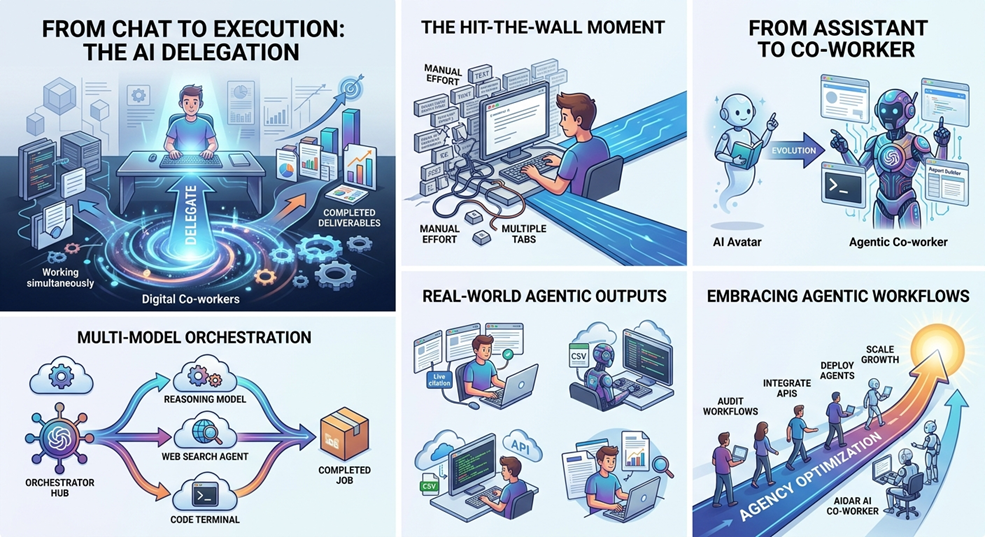
The Hit-the-Wall Moment with Standard Chatbots
Traditional chatbots give answers, but they don’t do the heavy lifting. They act like advisors standing behind your chair while you do all the manual labor. That hit-the-wall feeling with standard AI chat interfaces has pushed the tech world into its next major leap: autonomous AI agents.
Enter the Era of Autonomous Execution
Enter Perplexity’s digital worker agent—specifically built around systems like Perplexity Computer. This isn’t just another conversational chatbot meant for quick Q&A. It represents a fundamental transition from reactive conversational bots to autonomous digital co-workers capable of executing complex, multi-step workflows while you focus on high-level strategy.
The Paradigm Shift: From Reactive Information Assistant to Autonomous Co-Worker
Why Prompting Is Becoming Yesterday’s Bottleneck
For the last few years, our relationship with artificial intelligence has revolved around prompt engineering. You spent time carefully crafting instructions, tweaking context windows, and praying the model didn’t hallucinate halfway through a lengthy output. But prompting a standard Large Language Model (LLM) is fundamentally reactive.
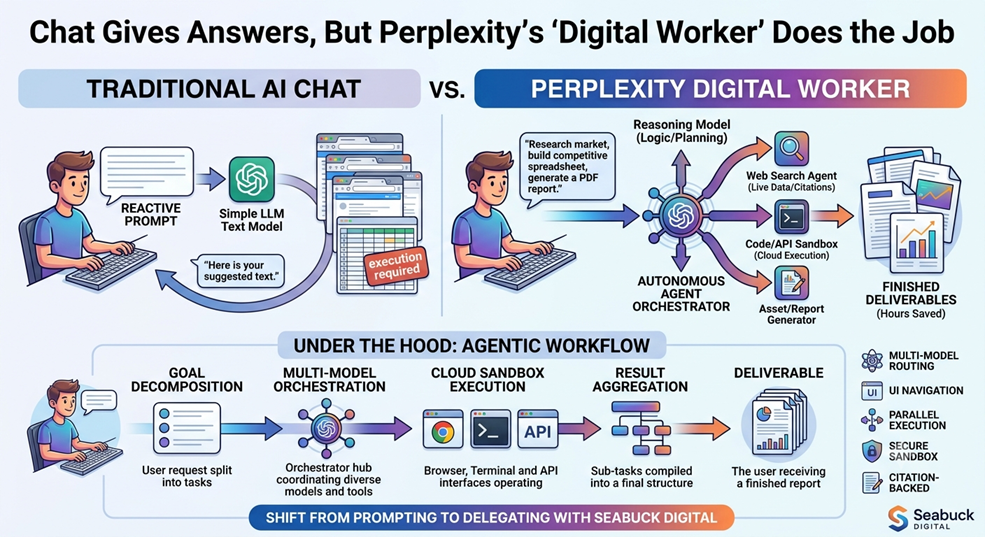
When you ask a chat interface to analyze a competitor’s pricing strategy, it gives you text. You still have to visit the websites, extract live pricing data, build a spreadsheet, generate charts, and build a presentation slide deck. The chatbot gives you information, but the operational burden remains on your shoulders. Prompting has officially become a bottleneck for modern business productivity.
| TRADITIONAL CHATBOT WORKFLOW User Prompt -> Single Model -> Text Output -> User (User manually executes all tools, browser, & code) |
| VS |
| DIGITAL WORKER AGENT WORKFLOW |
| User Goal -> Multi-Model Orchestrator -> Sub-Agents (Browser + Cloud Sandbox + APIs -> Finished Job) |
What Makes Perplexity’s Digital Worker Truly Action-Oriented?
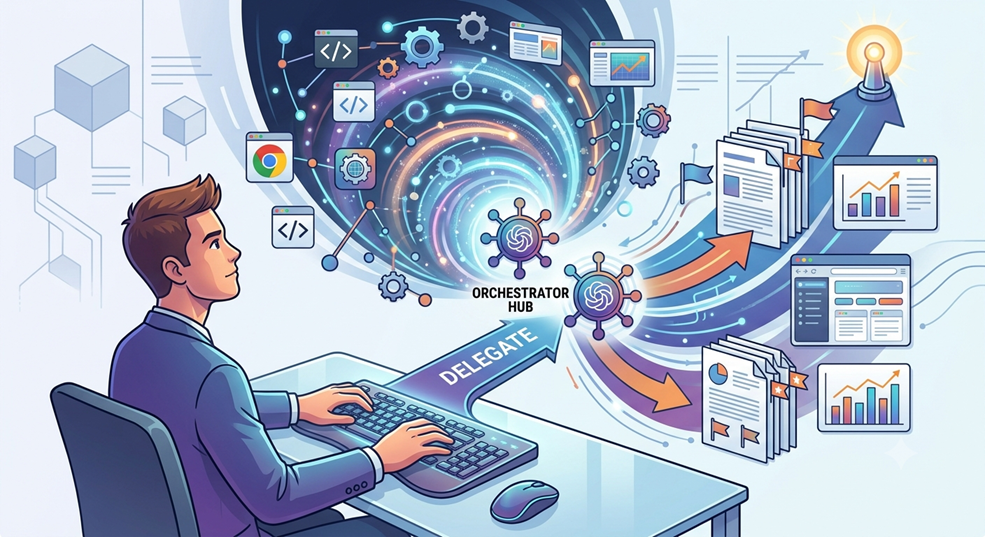
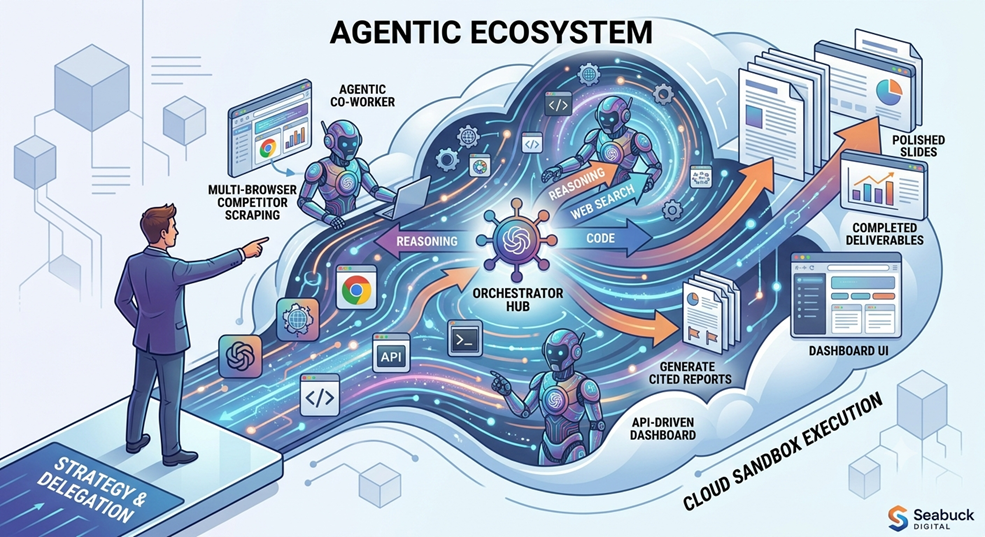
A digital worker agent doesn’t just talk about doing something—it steps up to the keyboard and completes the task. Instead of responding with raw advice, Perplexity’s agent takes an overarching goal, breaks it down into granular subtasks, delegates those subtasks to specialized tools or AI models, operates real user interfaces, and delivers a completed project end-to-end.
Think of it like hiring an eager junior colleague. You don’t hand them step-by-step micro-instructions for every single click; you give them an objective, like “Prepare a competitive research report on our top three rivals by tomorrow.” The digital worker handles the research, collects the visual assets, compiles the data, formats the file, and hands you the final deliverable.
Inside the System: How Perplexity’s Digital Worker Orchestrates Tasks
Multi-Model Orchestration vs. Single-Model Bottlenecks
One of the biggest limitations of traditional AI chat applications is their reliance on a single foundational model at a time. If you use a single model, you are stuck with its specific strengths and weaknesses. Reasoning models might excel at coding logic but lack real-time web awareness; specialized search models gather live web information quickly but struggle with long-form storytelling.
| Perplexity Orchestration Engine | ||
| [Reasoning Engine] (Complex Logic/Code) | [Deep Research Agent] (Real-Time Web Scrapes) | [Creative Assets Agent] (Images, Video & Graphics) |
Perplexity’s digital worker agent breaks free from this single-model bottleneck through intelligent multi-model orchestration. It acts as an orchestrator, routing individual components of a project to the absolute best engine for that specific micro-task:
- Deep Reasoning & Logic: Uses advanced reasoning models to plan strategies and analyze data structures.
- Real-Time Web Intelligence: Leverages specialized search-native engines to scrape live, cited data directly from the web.
- Asset & Visual Generation: Dispatches visual models to generate graphics, render media, or organize diagrams seamlessly alongside raw text.
Break It Down: How Sub-Agents Handle Complex Workflows
How does this actually happen under the hood? The digital worker agent uses specialized sub-agents working in parallel.
When you assign a large project, the primary agent decomposes your goal into discrete stages. Sub-Agent A searches the web for market statistics. While Sub-Agent A is fetching that data, Sub-Agent B is running code in the background to clean up an incoming CSV file. Simultaneously, Sub-Agent C writes a formatted markdown document incorporating both the statistical research and the structured data. The system coordinates these handoffs automatically, drastically shaving off execution time.
UI Navigation and Cloud Sandboxing: Under the Hood
You might wonder: how does an AI actually click buttons, use apps, and manage files without messing up your personal desktop?
Perplexity’s digital worker operates inside isolated cloud execution environments (sandboxes). It gets access to real browsers, cloud filesystems, code terminals, and app integrations without requiring messy local installations. It can open web applications, run Python scripts to process information, interact with APIs, and format files safely. If a task runs into an unexpected roadblock—like an API failing or a page layout changing—the agent creates a dedicated debugging sub-agent to fix the issue on the fly.
Chatbots vs. Digital Workers: Key Differences Breakdown
To help you visualize how dramatic this jump is, here is a breakdown comparing yesterday’s conversational chatbots with today’s autonomous digital worker agents:
| Feature / Metric | Traditional AI Chatbot | Perplexity Digital Worker Agent |
| Primary Mode | Reactive (Responds only when prompted) | Autonomous (Executes multi-step goals) |
| Output Type | Conversational text, simple code snippets | Finished files, built apps, dashboards, reports |
| Model Usage | Single model per session | Multi-model orchestration (routinely switches engines) |
| Execution Environment | None (Outputs static text in a chat window) | Cloud sandbox with real browser, terminal & APIs |
| Workflow Capability | Short context, step-by-step prompting | Long-running asynchronous execution (runs for hours) |
| Human Effort Needed | High (User does all formatting & tool switching) | Low (User reviews and approves final deliverables) |
Practical Use Cases: Replacing Hours of Manual Multi-Tool Juggling
Deep Research & Market Strategy Without the Tab Overload
If you have ever spent a Sunday afternoon opening 30 browser tabs to assemble a competitive matrix for your executive team, you know how tiring manual research is.
With a digital worker agent, you simply prompt: “Perform a complete market analysis of top SaaS tools in our niche, pull their updated pricing, summarize user sentiment from recent forums, and deliver a formatted strategic summary report.”
Instead of listing steps for you to take, the agent opens instances of real browsers, navigates through review platforms, extracts key metrics, cross-references sources, and packages the entire output into a clean, ready-to-share document. What used to take six hours of tab-switching now happens quietly in the background while you grab a coffee.
| ANATOMY OF AN AUTONOMOUS WORKFLOW | |
| 1. Goal Input -> | “Build a market teardown report.” |
| 2. Execution -> | Agent launches headless browser & code sandbox. |
| 3. Task Parallel -> | Sub-Agent A scrapes data | Sub-Agent B builds charts |
| 4. Deliverable -> | Outputs finished markdown report + CSV dataset. |
Automated Operations, Lead Enrichment, and Custom Web Dashboards
The implications for digital marketing agencies, growth teams, and founders are massive. Consider lead enrichment: instead of manually looking up prospect details, you can delegate a digital worker to pull lead emails, cross-reference their LinkedIn data, run web searches to identify company news, and populate your CRM.
Need a quick internal tool? The agent can pull raw data from connected software apps, write a custom HTML/JS dashboard, test it inside its sandbox environment, and hand you a functioning web application ready for deployment.
The Strategic Takeaway for Founders & Marketers
The Evolution of Workflow Design: From Prompting to Delegating
As digital marketers and business leaders, our skill set must adapt. For the past few years, the highest-valued skill was knowing how to write a good prompt. Moving forward, the highest-valued skill will be workflow architecture.
Instead of micro-managing an AI line by line, successful operators will excel at defining clear outcomes, setting guardrails, establishing data constraints, and evaluating final deliverables. You stop being a writer micro-managing a copy editor; you become a creative director overseeing a team of tireless digital specialists.
How Search Engine Optimization Meets Agentic AI
From an SEO and Answer Engine Optimization (AEO) perspective, this shift alters how information is consumed. As autonomous agents search the web to fulfill tasks for human users, they aren’t just looking for simple answers—they are fetching structured, reliable, highly cited data.
If your website content is thin, unstructured, or lacks clear authority, AI agents will skim right past it. But if your brand publishes deeply insightful, authoritative, well-structured content, digital worker agents will cite your data, integrate your insights into executive summaries, and route high-intent traffic directly to your ecosystem.
The Future Outlook: How Businesses Should Adapt to Agentic Workflows
Preparing Your Business Stack for Autonomous Systems
The arrival of autonomous digital workers isn’t just a minor update—it’s a fundamental restructuring of digital operations. To stay competitive, companies should begin auditing their daily processes:
- Identify Repetitive Multi-Tool Sequences: Look for tasks where team members copy data from one tool, reformat it, and paste it into another.
- Structure Internal Knowledge: Ensure your company documents, guidelines, and assets are cleanly formatted so AI agents can query them easily through app connectors.
- Shift Mindsets to Outcome Delegation: Train your team to write goals based on outcomes rather than basic conversational prompts.
By making these adjustments now, you position your team to operate with unprecedented speed and efficiency.
Conclusion
We are witnessing the end of the “chatbot era” and the beginning of the “agentic execution era.” Standard chat interfaces were a great starting point, but they left us doing all the tedious manual work. Perplexity’s digital worker agent proves that AI can do far more than just return text. By combining multi-model orchestration, parallel sub-agent execution, and secure cloud sandboxing, it takes your strategic goals and turns them into completed, real-world deliverables.
The future belongs to those who stop treating AI as a search bar and start utilizing it as an autonomous digital workforce. Are you ready to delegate the work and focus on growing your vision?
Frequently Asked Questions (FAQs)
What is a Perplexity digital worker agent?
A Perplexity digital worker agent (such as Perplexity Computer) is an autonomous AI system designed to create, coordinate, and execute entire multi-step workflows. Unlike standard chatbots that simply answer questions, a digital worker operates browsers, executes code, manages files, and uses multiple specialized AI models to complete entire projects independently.
How does Perplexity’s digital worker differ from standard ChatGPT or Gemini?
Standard chat interfaces like ChatGPT or Gemini are primarily reactive—you prompt them, and they output text or code snippets for you to handle manually. Perplexity’s digital worker is action-oriented: it breaks down your prompt into subtasks, launches dedicated sub-agents, uses real cloud-based browsers and terminals, and delivers completed assets asynchronously while you work on other tasks.
Do I need coding skills to use an autonomous AI agent?
No programming skills are required! You simply state your goal in plain, conversational language. The digital worker agent takes care of writing necessary scripts, running calculations, fetching web data, and formatting deliverables behind the scenes.
Is my data safe inside cloud sandboxing environments?
Yes. Modern digital worker agents run workflows inside isolated cloud sandboxes. This means operations—such as scraping data, compiling code, or manipulating files—happen in a secure, segmented container without posing security risks to your personal device or private networks.
How does multi-model orchestration actually improve my output quality?
No single AI model is best at everything. Multi-model orchestration automatically assigns specialized parts of your request to different models. For example, it might use a high-reasoning model for logic, a search-native model for real-time web research, and a dedicated image model for graphics. This ensures every component of your final output is crafted by the best tool available.