

Introduction
Are you still keyword-stuffing your Amazon titles like it’s 2018? If so, your organic rank is likely bleeding.
The era of simply jamming target terms into a title field and watching sales roll in is officially over. Amazon’s search infrastructure has undergone a massive evolution. Today, algorithms don’t just count exact keyword matches; they parse semantic context, infer intent, and answer direct customer questions through AI shopping assistants.
Choosing the best Amazon listing optimization tool isn’t about finding the one with the flashiest dashboard. It’s about methodology and scale. A solo bootstrapped seller launching a single private label product requires a vastly different stack than an enterprise agency managing 2,000 SKUs.
Let’s break down how the search landscape operates in 2026, evaluate top software options based on seller intent, and help you pick the exact tool for your operational scale.
The Modern Amazon Context: Why Standard Tools Fail in 2026
The Algorithmic Shift: Moving Beyond A9 to COSMO and Rufus
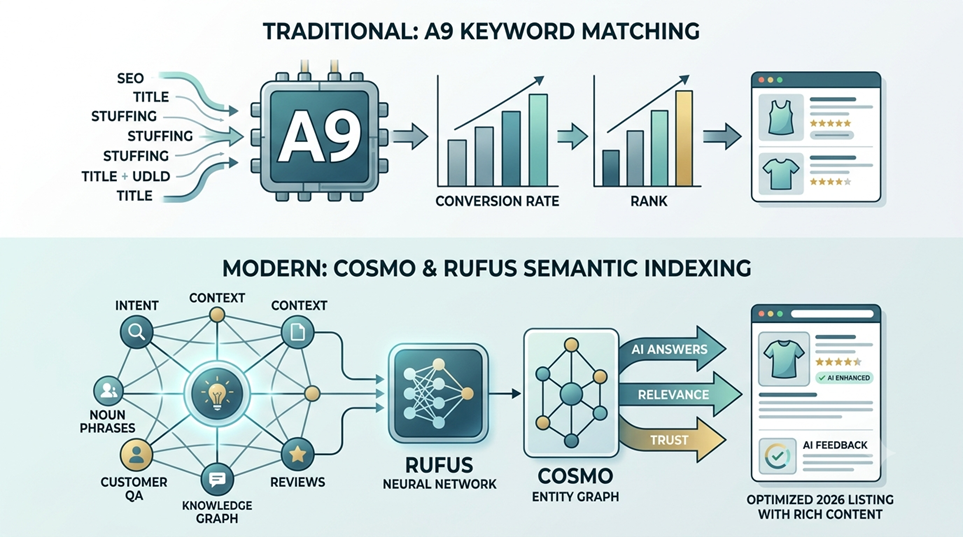
For years, sellers optimized exclusively for the A9 algorithm—a engine focused on direct text matching and historical conversion rates. Today, your listings must satisfy two newer, highly intelligent systems: COSMO and Rufus.
- COSMO (Knowledge Graph Engine): COSMO maps intent relationships. It doesn’t just ask, “Does this page contain the word ‘shoes’?” It asks, “Is this shoe suitable for marathon runners with wide feet based on structured attributes?”
- Rufus (Generative AI Assistant): Rufus acts as a digital personal shopper. It reads your title, bullets, A+ Content, images, Q&A, and review sentiment to generate natural answers.
If your listing is filled with disjointed, keyword-stuffed strings, Rufus will flagged it as low-confidence and bypass your product entirely. Modern tools must write for semantic AI while keeping natural human readability intact.
| AMAZON SEARCH ENGINE | |
| Traditional (A9 Engine) | Modern (COSMO & Rufus) |
| Exact keyword matching High keyword density Rigid character limits Text-only indexing focus | Intent & entity graphs Noun phrase readability OCR & visual readability Holistic UGC/Review trust |
The 4 Pillars of 2026 Listing Architecture
To achieve top-tier indexing today, a software tool must cover four distinct optimization pillars:
- Title & Bullet Noun-Phrase Alignment: Structuring copy using complete feature + benefit + context phrases.
- Backend & Attribute Precision: Filling every category listing report (CLR) attribute field to prevent data drop-offs in COSMO’s Knowledge Graph.
- Visual & Multimodal SEO: Ensuring your infographics feature clean, optical character recognition (OCR)-friendly text that AI tools can scan.
- Post-Publish Tracking & Sentiment Alignment: Monitoring how customer review language compares to your listing claims.
Direct Evaluation Matrix: Quick Tool Comparison
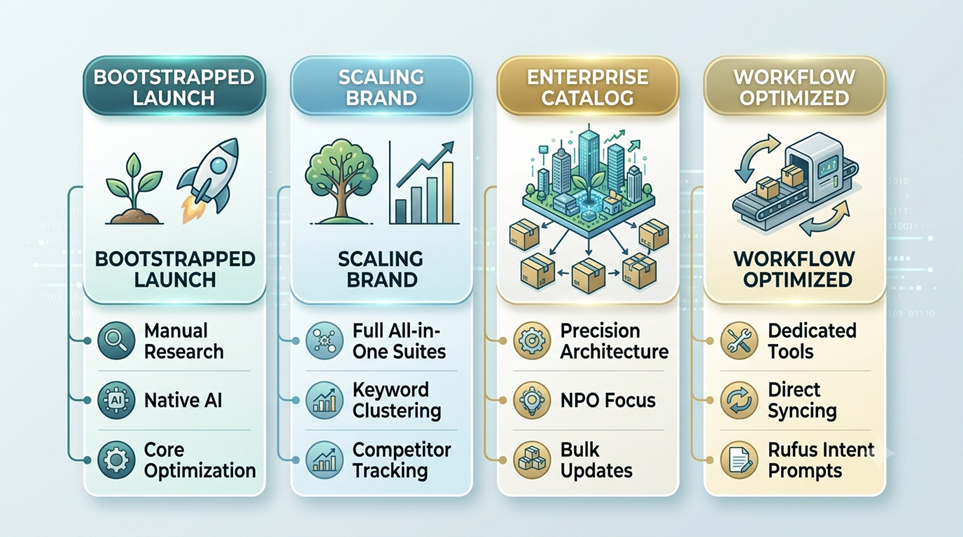
| Category / Use-Case | Leading Tools | Value Angle / Primary Focus | Pricing Tier |
| Full All-in-One Suites | Helium 10 (Listing Builder) & Jungle Scout | Deep keyword databases integrated with AI copy generation and full seller ops. | Mid to High ($99–$279+/mo) |
| Precision Listing Architecture | Data Dive | Data-heavy keyword clustering, Master Keyword Lists (MKL), and ranking methodology. | High ($149–$499+/mo) |
| Dedicated Workflow & Automation | Keywords.am / ZonGuru Helix | Streamlined copy generation, direct Seller Central syncing, and Rufus intent prompts. | Mid ($49–$199/mo) |
| Free & AI-Assisted Foundations | Native Amazon AI + ChatGPT/Claude | Zero-cost baseline copy generation for early-stage sellers needing initial structure. | Free to Low ($0–$20/mo) |
Tool Deep Dives: Categorized by Seller Intent and Methodology
Category 1: Full All-in-One Enterprise Suites
Helium 10 (Listing Builder)
Helium 10 remains an industry giant because it connects keyword discovery (Cerebro/Magnet) directly into its Listing Builder workspace.
- Strengths: Helium 10’s Listing Builder features dedicated toggles to optimize specifically for Amazon Rufus. It allows you to import competitor ASINs, analyze customer question patterns, and automatically move unused long-tail keywords into backend generic search fields. It tracks keyword distribution in real time so you don’t over-optimize or duplicate phrases.
- Trade-Offs: The full platform can feel complex for solo sellers, and its best AI generation features are locked behind higher-tier subscription plans.
Jungle Scout
Jungle Scout takes a user-friendly approach, combining historical sales estimates with its AI Listing Builder powered by OpenAI models.
- Strengths: Excellent for sellers who prioritize simplicity. Its AI tool takes existing keyword lists and produces solid, natural-sounding drafts within seconds. It offers clear Listing Quality Scores (LQS) that evaluate titles, character counts, and image quantities simultaneously.
- Trade-Offs: Less granular than specialized tools when it comes to deep keyword grouping or advanced entity mapping.
Category 2: Precision Listing Architecture & NPO
Data Dive
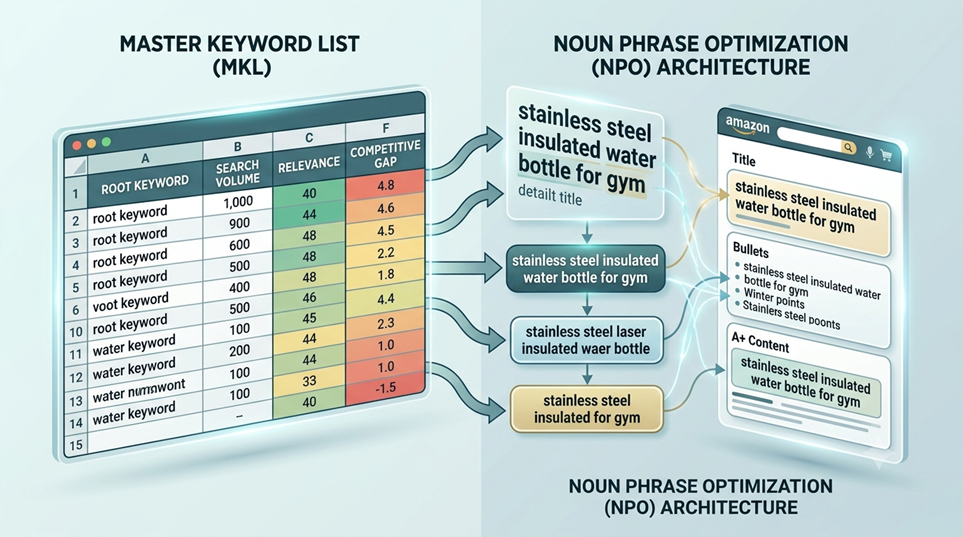
Data Dive is built specifically for analytical, data-obsessed brand builders. It integrates directly with Google Sheets and Helium 10 API keys to automate deep competitive analysis.
- Strengths: Data Dive shines in Noun Phrase Optimization (NPO) and master keyword list structuring. Instead of throwing a bag of words at a page, it shows you exactly how top competitors structure their listings to capture rank juice. It highlights EXACT root coverage gaps across your main competitors.
- Trade-Offs: It requires a steep learning curve. It is not an “automated one-click writer”—it is a strategic blueprint builder that requires a knowledgeable operator to yield results.
Category 3: Dedicated Workflow Optimization & Automation
Keywords.am & ZonGuru Helix
These specialized platforms focus specifically on the copywriting and publishing workflow rather than broad business analytics.
- Strengths: ZonGuru’s Helix tool combines Search Query Performance (SQP) data with GPT-driven listing optimization customized for Rufus intent. Keywords.am focuses heavily on fast, seamless listing updates and backend syncs directly to Seller Central, making catalogue overhauls fast.
- Trade-Offs: Lacks broader business tools like inventory tracking or financial forecasting, meaning you may still need supplementary tools for wider business operations.
Category 4: Free & AI-Assisted First Draft Foundations
Native Amazon AI & Custom LLMs (ChatGPT / Claude)
For bootstrapped sellers, Amazon now offers native AI listing generation directly inside Seller Central. Alternatively, custom prompts in ChatGPT or Claude can construct strong listing copy.
- Strengths: Zero or low financial cost. Great for taking basic bullet points or product spec sheets and rewriting them into grammatically clean, natural English sentences.
- Trade-Offs: These tools lack real-time search volume metrics and competitor keyword indexing data. Relying entirely on generic LLMs without an underlying keyword strategy often results in high-sounding copy that fails to index for critical search terms.
Strategic Decision Framework: How to Choose for Your Catalog
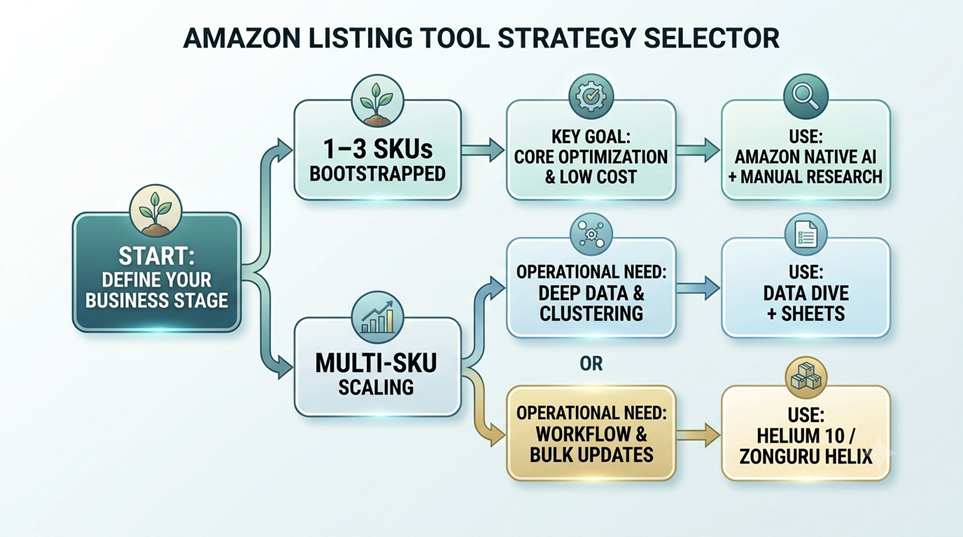
Selecting the right software comes down to evaluating your catalog scale against your technical capability:
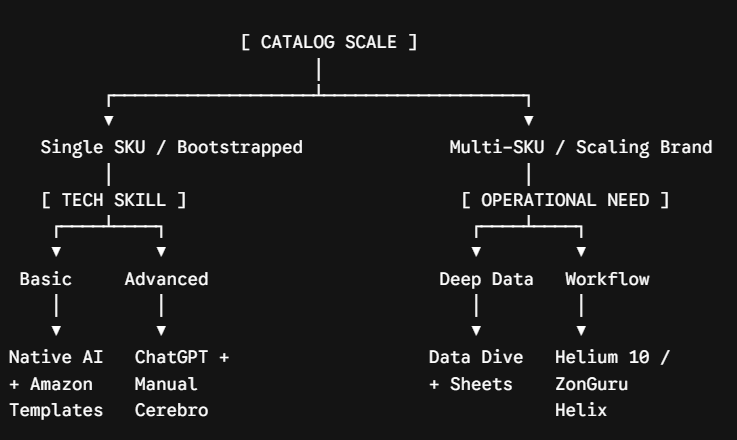
Bootstrapped / Launch Stage (1–3 SKUs): Start with Amazon’s Native AI combined with manual keyword research from targeted, pay-as-you-go keyword reports. Focus on getting a clean, readable listing live without heavy software overhead.
- Fast-Growing Private Label (3–20 SKUs): Upgrade to Data Dive or Helium 10. You need deep competitive keyword mapping to win market share from established incumbents.
- Catalog Brand / Agency Level (50+ SKUs): Prioritize Helium 10 (Listing Builder) or ZonGuru Helix for bulk optimization workflows, Rufus alignment tools, and direct Seller Central API publishing.
Agency Perspective: Software vs. Managed Optimization
The Limits of Automation in E-Commerce Scaling
Software tools provide data, metrics, and initial drafts—but software alone cannot understand your product’s physical nuances or distinct brand identity.
A tool might suggest placing the word “cheap” in your title because of raw search volume, but a human strategist knows that doing so damages your luxury brand positioning. High-converting listings require an operator who balances algorithm indexing requirements with genuine human persuasion.
Weaving Off-Amazon Authority and Digital PR into Your Strategy
Optimizing your detail page is only half the battle. Amazon’s internal search algorithm increasingly weighs external traffic signals and off-page brand authority.
When off-Amazon digital PR, high-tier editorial link building, and targeted publisher placements send quality traffic to your Amazon listings, your conversion rates rise. This signals to both COSMO and A9 that your product is a market leader, driving organic keyword positions higher than on-page text optimization could achieve alone.
Conclusion
There is no single best Amazon listing optimization tool. The best tool is the one that aligns with your seller stage, catalog scale, and strategic approach.
If you need automated, catalog-wide scale, tools like Helium 10 excel. If you want surgical, data-dense keyword clustering, Data Dive is an unmatched asset. And if you’re just starting, leveraging customized LLM workflows will get you off the ground without breaking the bank.
Remember: tools provide the raw material, but strategy drives the revenue. Pair your software stack with strong off-page digital PR, sound brand positioning, and relentless conversion optimization to dominate your category on Amazon.
FAQs
1. How has Amazon Rufus changed keyword placement rules in 2026?
Amazon Rufus relies on generative AI to answer natural-language customer queries. It favors full noun phrases, clean conversational context, complete backend attribute fields, and verifiably positive review sentiment over disjointed, repetitive keyword strings.
2. Can I rank on Amazon by using ChatGPT alone without dedicated Amazon tools?
While ChatGPT can write well-structured, persuasive copy, it lacks real-time Amazon search volume data, backend character constraints validation, and competitive indexing metrics. It is best used as a drafting assistant alongside dedicated keyword discovery software.
3. What is Noun Phrase Optimization (NPO) and why is it essential now?
Noun Phrase Optimization is the practice of structuring your title and bullet points around complete concept phrases (e.g., “Leak-proof stainless steel water bottle for gym workouts”) rather than fragmented keywords. This helps semantic algorithms like COSMO index your product for intent-based searches.
4. How often should I re-optimize my Amazon product listings?
You should review and audit your listings quarterly, or whenever you notice a sustained drop in organic rank or conversion rate. Additionally, whenever Amazon introduces new detail page attributes or category requirements, update your backend data immediately.
5. How does external off-Amazon traffic impact my on-page Amazon optimization?
External traffic generated from digital PR, press coverage, and strategic link building drives high-intent visitors directly to your detail page. The resulting conversion spikes signal high relevance to Amazon’s algorithms, boosting your organic keyword rankings faster than on-page copy adjustments alone.