
Introduction
Here’s something most site owners don’t want to hear: the traffic problem you’re trying to fix with more content is usually a quality problem wearing a traffic costume.
You publish three times a week. You hit the keywords your research turned up. Rankings still stall, and somehow a competitor putting out half as much content is pulling ahead. It’s not that they found some secret keyword you missed. It’s that their pages hold up when something a search engine, or increasingly an AI system summarizing search results actually looks closely at them.
That distinction is much more important than it was a couple of years ago. Google used to be the only game in town when it came to the top ten blue links. There’s a second, softer game taking place, too: whether your page is sufficiently valuable and authoritative to cite in an AI-generated overview by Google, ChatGPT, or Perplexity. Both games are played the same way and have content that can stand up to scrutiny.
Understanding Organic Search Visibility
Organic search visibility is the metric that represents the overall share of voice your website owns in non-paid search engine results. Unlike a single keyword ranking (e.g., being #1 for “best running shoes”), visibility calculates your footprint across your entire keyword universe. It takes into account your rankings for thousands of related search queries, factoring in the search volume of those terms and the estimated click-through rate (CTR) of your positions.
In short, if your organic search visibility is high, your brand appears consistently wherever your target audience looks, building immediate trust before a user even clicks.
The Mechanics: How Quality Control Dictates Visibility
When a site shifts from mass-producing low-quality pages to enforcing strict quality checks, its organic search visibility changes in three distinct ways:
- Keyword Footprint Expansion: High-quality, deep content naturally answers secondary and long-tail questions (highly specific search queries). Instead of ranking for just one target keyword, a single authoritative page might visible for hundreds of related terms.
- Algorithmic Trust & “Halo Effect”: Search engines like Google evaluate websites sitewide. When your quality control eliminates flat, duplicate, or unhelpful content, the overall domain authority rises. This “halo effect” makes it easier for new content to achieve high visibility right out of the gate.
- Protection Against Core Algorithm Updates: Algorithm updates are designed to filter out the “content flood” mentioned in the article. Sites with high visibility built on shallow, unedited AI content often experience sudden, catastrophic visibility drops. Conversely, sites with strict content guardrails see their visibility remain steady or climb during updates.
Key Metrics to Track Visibility
To know if your quality control strategy is actually moving the needle, you should monitor these three metrics rather than just looking at raw traffic:
| Metric | What It Measures | Why It Matters for Quality |
| Share of Voice (SoV) | Your percentage of clicks for a specific cluster of industry keywords compared to competitors. | Shows if your depth is stealing market share from competitors who publish twice as often. |
| Average Position Trends | The macro-movement of all your indexed keywords over time. | If your average position improves while your total published pages stay flat, your quality control is working. |
| AI Citation Share (GEO) | How often your brand is named or linked in AI Overviews, Perplexity, or ChatGPT. | The ultimate test of modern visibility—proving your content is structured and clear enough to be synthesized. |
The Content Flood Problem
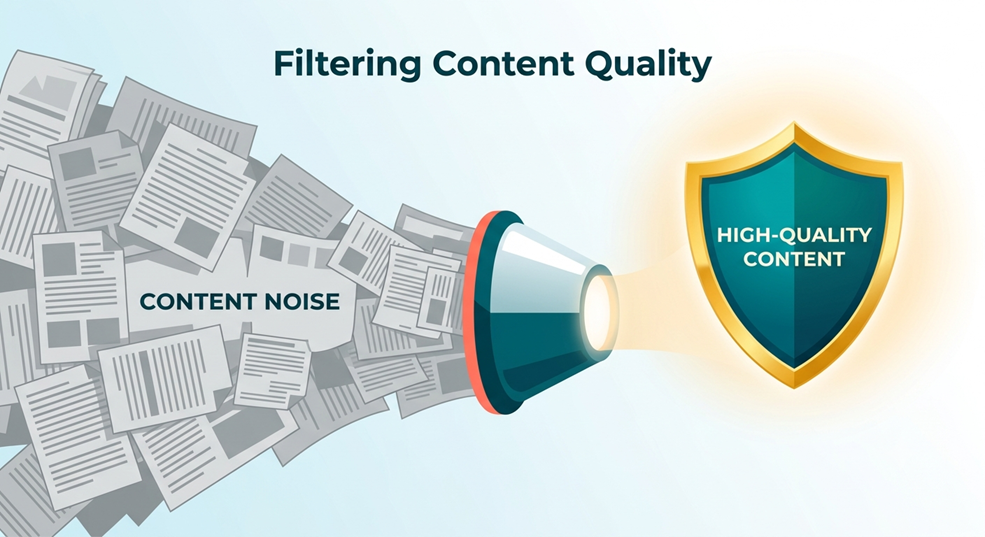
There’s just more content out there than there used to be, full stop. AI writing tools made publishing cheap, so instead of competing against a few dozen similar articles, a new page is often competing against thousands of near-identical ones. Google has leaned into this in its own guidance on people-first content, pushing harder toward rewarding originality and depth while quietly demoting anything that reads like a reshuffled version of what’s already ranking.
What tends to break through isn’t the longest post or the one stuffed with the most keywords. It’s the one that sounds like a person who actually understands the subject sat down and wrote it specific, structured, and without a lot of throat-clearing before it gets to the point.
Quality Control Isn’t a Final Step Anymore
For a long time, “quality control” meant a spellcheck pass right before hitting publish. That’s not where the bar sits now. A more honest quality check asks three things before anything goes live:
- Does this say something original, or does it just rearrange the top five search results?
- Would every claim in here survive someone fact-checking it?
- Is there anything a reader couldn’t already get from skimming the first page of results?
If a piece fails any of those, no amount of technical SEO polish saves it for long.
Originality, Accuracy, and Depth Are What Get Trusted
Search algorithms and language models are both, in their own ways, looking for signs that content can be trusted. Consistent accuracy, real originality, and actual depth are what separate a page worth citing from one worth skipping past. This isn’t abstract; it shows up in rankings that hold steady versus ones that spike and fade within a month.
Duplicate Content Is Quieter Than People Think
The thing that surprises people is that many under-performing pieces of content are not poorly written. It is as unoriginal as the writer never realized. If it seems like plagiarism if you skim it, it is, and if it seems like the same group of sentences is repeated over five pages of the same site, well, that’s some plagiarism, too.
That’s usually the missing step, not a lack of effort. Most writers aren’t trying to copy anyone. They just don’t realize how close a paraphrase can drift to its source until they actually put the two side by side. Running a draft through an online plagiarism remover before it goes live is a quick way to catch that it takes a couple of minutes, points out the lines that are echoing another source too closely, and gives you a chance to reword them while it’s still easy. Moz has a solid breakdown of how duplicate content dilutes authority, even when none of it was copied on purpose worth a read if this feels like a new concept.
Where AI-Assisted Drafting Actually Goes Wrong
Using AI to help draft something isn’t the issue. Publishing that draft without touching it is.
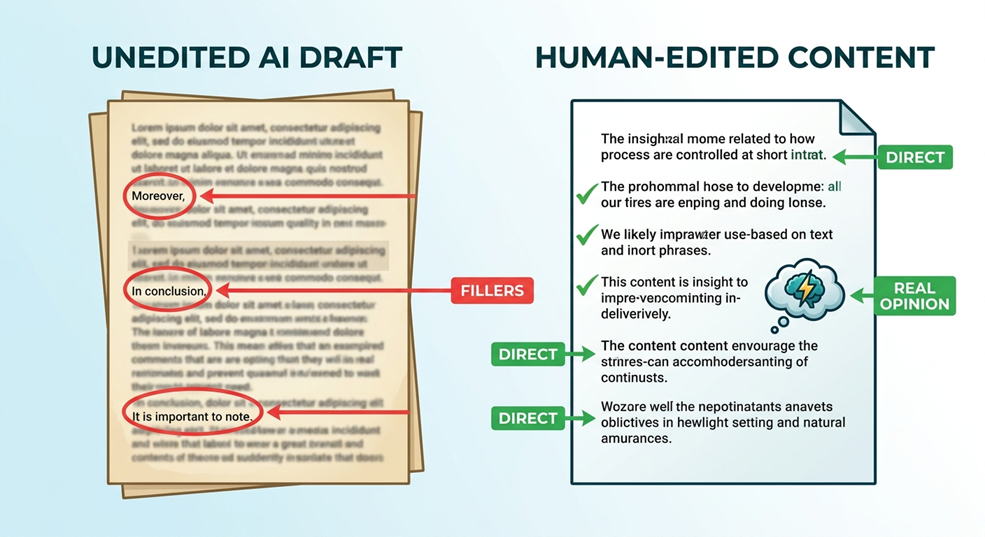
A first draft written with AI assistance often has a certain rhythm to its sentences that are all roughly the same length, transitions that repeat (“Moreover,” “In conclusion,” “It’s important to note”), and a flatness where a real opinion should be. None of that is fatal on its own, but stacked together it reads as generic, and generic doesn’t get cited or shared.
Fixing this is mostly an editing problem, not a tooling problem. Reworking sentence rhythm, cutting the filler transitions, and putting an actual point of view back into the writing turns a passable draft into something worth reading. It’s the same fix whether the flat, repetitive tone came from an AI tool or just a rushed first draft either way, someone has to go back through and make it sound like a person again. Some writers use an AI text humanizer at this stage to smooth that tone out before a human editor takes the final pass, which cuts down on how much rewriting is left by the time someone actually sits down with the piece. Skip that step entirely, though, and ship the raw draft as-is, and it shows not in any one obvious way, but in a flatness, readers pick up on even if they can’t quite say why.
A Simple Pre-Publish Check Worth Doing Every Time
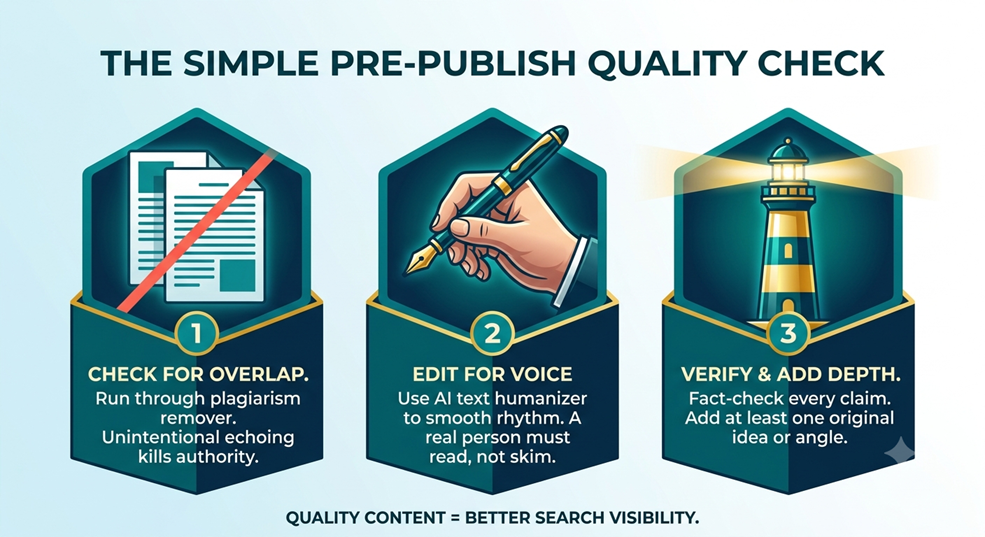
Three things, done in order, catch most of what quietly caps a page’s performance:
- Check for overlap. Run the draft through a plagiarism remover to confirm it isn’t unintentionally echoing what’s already out there.
- Edit for voice. Use an AI text humanizer to smooth out the rhythm and phrasing issues that make AI-assisted drafts sound alike, then have a person read it start to finish rather than skim it.
- Verify and add something. Fact-check every claim, and make sure the piece includes at least one idea or angle the top-ranking pages don’t already cover.
None of this takes long. It just has to actually happen, every time, instead of being the step that gets skipped when a deadline is close.
Writing for AI Search, Not Just Search Engines
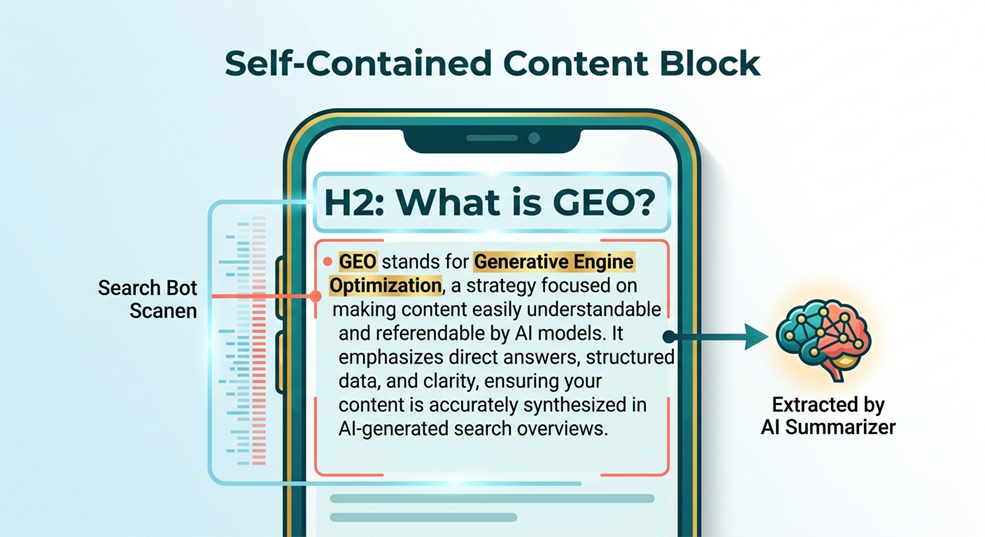
Generative Engine Optimization adds something traditional SEO never had to think about: getting pulled into an AI-generated answer, not just ranked on a results page. That tends to favor sections that can stand alone with a heading that implies a clear question, followed by a direct answer, rather than a section that meanders for three paragraphs before saying anything. Vague or padded sections rarely make it into an AI Overview or a chatbot’s summary, no matter how well the page ranks otherwise. Search Engine Journal’s ongoing coverage of how AI Overviews pull and cite sources is worth a look if you want to see this pattern play out in real examples rather than theory.
Quality Control Is the Strategy
Publishing more isn’t what wins search visibility anymore. Publishing content that holds up to a curious reader, to a search algorithm, and to whatever AI system is deciding what’s worth referencing is what wins it. Checking drafts for unintentional overlap, editing AI-assisted writing until it actually sounds like someone wrote it, and holding every piece to a real bar before it ships isn’t extra work tacked onto content production. At this point, it’s just what content production means.
FAQs
Does writing with AI assistance hurt SEO?
Not by itself. Google has said repeatedly that it rewards helpful content regardless of how it was produced. The risk isn’t AI involvement; it’s shipping unedited AI output without anyone actually reading it first.
How often should content be checked for duplication before publishing?
Every time, not occasionally. It takes a few minutes and catches problems that are much harder to undo once a page has been indexed and already lost ranking.
Can a single low-quality section damage the visibility of an entire website?
Yes. Google evaluates websites using both page-level and site-wide quality signals. If a substantial portion of your site consists of unoriginal, duplicate, or heavily automated content without human oversight, it creates a “sitewide drag.” This lowers the algorithmic trust of your entire domain, making it much harder for even your highest-quality pieces to achieve top organic visibility.
How does content formatting affect both SEO and AI search visibility (GEO)?
Traditional SEO requires clear formatting (like H2 and H3 tags) to help search crawlers understand the page hierarchy. Generative Engine Optimization (GEO) takes this a step further: AI summarizers look for highly concise, self-contained blocks of information. If your section starts with a clear question-based heading and immediately follows it with a direct, data-backed answer, an AI system can easily extract and cite that block. If the answer is buried deep within paragraphs of filler text, the AI will skip it entirely.
What’s the real difference between SEO and GEO?
SEO is about ranking on a results page. GEO is about being pulled into an AI-generated answer or summary, which tends to reward writing that’s clear and self-contained enough to be quoted on its own, section by section.