
The Great Search Shift: Why Traditional Clicks Are Dying
The Death of the 10 Blue Links
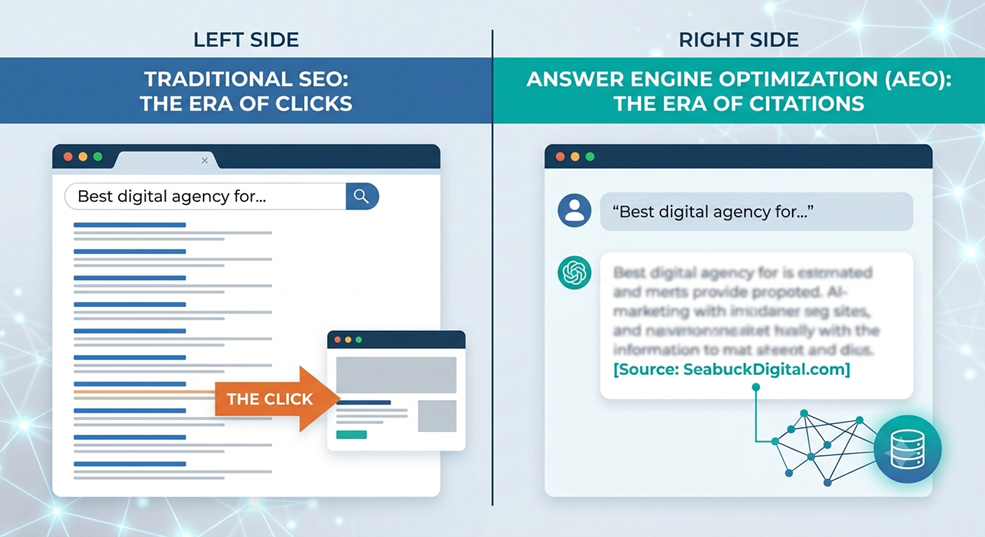
Remember the golden era of SEO? You’d identify a high-volume keyword, write an 800-word blog post stuffed with synonyms, rank on page one, and watch the traffic roll in. Those days are rapidly evaporating. We are witnessing a monumental migration away from traditional Search Engine Optimization toward Answer Engine Optimization (AEO) and Generative Engine Optimization (GEO). Users don’t want a scavenger hunt across ten different websites just to find a single answer. They want the answer served to them on a silver platter, summarized, synthesized, and perfectly tailored to their exact query.
Would ChatGPT Recommend You Right Now? How to Optimize Content for ChatGPT
Let’s look at this through a terrifyingly simple lens. If a high-value potential client types your exact service into ChatGPT right now—say, “Who is the best digital marketing agency for enterprise scale in our region?”—will the AI pull your name out of its vast neural net, or will it confidently hand that client over to your competitor? Stop optimizing for clicks; start optimizing for citations. The battleground has shifted from winning a clickable link to becoming the trusted source that the large language model (LLM) cites.
Section 1: Decoding the Mind of the Machine: How ChatGPT “Thinks”
Static Brains vs. Live Eyes: The Data Sourcing Engine
To outsmart the algorithm, you have to understand exactly how it gathers information. ChatGPT isn’t just an advanced Google scraper. It operates using a hybrid system that blends historical memory with real-time observation.
The Foundation: Training Data and Corporate Partnerships
At its core, ChatGPT relies on an astronomical base of static training data—think archives like Common Crawl, digital libraries, and massive web scrapes. But here is the secret sauce: OpenAI actively signs licensing agreements with massive data goldmines. Deals with Reddit, Dotdash Meredith, and major media conglomerates mean that ChatGPT heavily favors these platforms. If your brand doesn’t have a footprint inside these trusted hubs, you are effectively invisible to the baseline model.
The Lens: Real-Time Web Integration via Bing
When users ask for breaking news or fresh data, ChatGPT activates its live eyes. Using integrations like Bing Web Search, it dynamically crawls the web to synthesize current answers. It functions like a hyper-fast research assistant that reads the top articles in milliseconds and drafts a summary. If your technical SEO makes it hard for a standard bot to parse your text quickly, ChatGPT will simply skip your site for an easier read.
The Currency of AI Search: Information Gain over Copycat Content
Here is a hard truth most agencies won’t tell you: the internet is drowning in generic, AI-generated fluff. When a search engine reads ten articles that say the exact same thing, why should it care about yours? ChatGPT prioritizes Information Gain. This is an algorithmic score that measures how much new, unique value your content provides compared to what the model already knows. If your content lacks fresh insights, proprietary data, or unique case studies, its information gain score drops to zero, and it gets filtered out of the final AI summary.
Section 2: The Tactical AEO Playbook: Engineering Content for LLMs
Step 1: Speak the Robot’s Language with Conversational Formatting
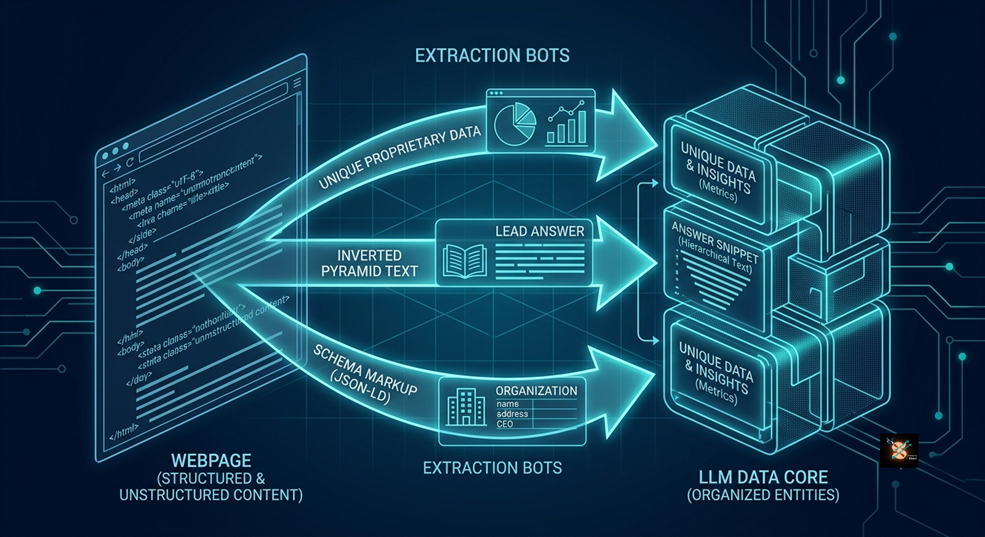
LLMs crave absolute clarity. They don’t have time to wade through romantic, flowery introductions. To optimize for conversational search, structure your content using the Inverted Pyramid model. Lead with the most crucial information immediately.
Adopt an explicit Q&A structure in your HTML. Use your H2 or H3 tags to phrase questions exactly how a human would ask them verbally or in a chat prompt. Right below that heading, make the very first sentence a direct, unambiguous answer. Think of it as feeding the model an easily digestible snippet it can copy-paste directly into its chat box. Save the background context and deep analysis for the paragraphs below.
Step 2: Injecting Data Gold—Proprietary Stats and Deep Case Studies
How do you guarantee a high information gain score? You publish things that cannot be replicated. Stop quoting public statistics that everyone else pulled from HubSpot five years ago. Instead, mine your own company data.
Publish your internal agency experiments, list your exact conversion metrics, and tell raw, unedited stories through comprehensive case studies. When you write, “In our Q1 experiment across 40 accounts, we found that AEO increased conversion efficiency by 34%,” you are creating an entirely new data point. ChatGPT loves hard numbers and expert quotes because they break the consensus and provide concrete evidence for its answers.
Step 3: Fixing Your Invisible Layer—Flawless Technical Schema
If your visual layout is for humans, your schema markup is the API for the machine. Do not force an LLM to guess what your page is about. Use flawless, explicit schema properties to define exactly who you are and what you offer.
Deploy advanced Organization, Product, and FAQ schema across your domain. If you publish a guide, wrap it in TechArticle schema. By structuring your metadata clearly, you are drawing a literal roadmap for the AI’s web-scraping bots, allowing them to map your entity, your relationships, and your expertise without wasting computational power.
Step 4: Off-Page Citations—Getting Talked About in the Right Ecosystems
Traditional SEO relies heavily on backlink authority. AEO relies on brand mentions and consensus. ChatGPT uses a variety of third-party platforms to validate its assertions.
If a user asks for software recommendations, ChatGPT will look at what real people are saying on G2, Capterra, and Reddit. If you want to optimize for ChatGPT, you need a robust digital PR strategy that targets these community hubs. Actively build your presence on Quora, ensure your Wikipedia data is highly accurate, and foster genuine conversations around your brand across digital forums. When the AI sees your brand consistently associated with a specific topic across multiple platforms, it registers your entity as a trusted industry leader.
Section 3: Flying Without a Dashboard: Measuring AI Search Success
The Mirage of Keyword Rankings
If you are still sending your clients monthly PDFs showing that they rank #3 for a generic keyword, you are tracking a ghost. In a world where search results are dynamically generated and personalized on the fly by an AI, static rank tracking is becoming obsolete. There is no permanent “spot” to track when the interface adapts to every user’s unique prompting behavior.
The Real-World Metrics: Brand Queries and Referral Traffic
So, how do we track success at Seabuck Digital? Look for the breadcrumbs left behind in your analytics.
- Direct Brand Queries: An increase in organic search volume for your specific brand name indicates that users saw your name inside an AI interface and went to Google to find your actual site.
- AI Referral Traffic: Keep a hawk-like eye on your referral traffic sources in Google Analytics. Look specifically for clicks landing from domains like chatgpt (dot) com, ai (dot) com, or perplexity (dot) ai.
- Manual Prompt Auditing: Build a spreadsheet of core industry queries and run regular manual prompt tests across different LLMs. Track whether your brand is mentioned, how confidently the AI recommends you, and whether it links back to your verified site.
Conclusion: Winning the Answer Engine Era
Optimizing for ChatGPT isn’t a temporary growth hack; it is the baseline requirement for digital survival. By shifting your perspective from chasing superficial clicks to building authoritative citations, you ensure that your business remains deeply embedded in the digital architecture of tomorrow. Structure your data clearly, produce undeniable, proprietary value, and build an untarnished off-page reputation. When you make it incredibly easy for the machine to trust your brand, it will reward you by making you the ultimate answer.
FAQs
Q1: Will optimizing my content for ChatGPT hurt my traditional Google SEO traffic?
Not at all. In fact, it will likely improve it. Google’s algorithms have heavily evolved into generative models themselves (such as Search Generative Experience). The exact same principles that make your content attractive to ChatGPT—such as direct answers, structured schema, and high information gain—are precisely what Google looks for to fuel its own AI summaries.
Q2: How often does ChatGPT update its knowledge base to find my new content?
It happens in two ways. For static training data, updates happen in large, infrequent batch cycles. However, for live queries, ChatGPT utilizes real-time search engines like Bing. If your new content is properly indexed by major search engines and cleanly formatted, it can be discovered and cited by ChatGPT within minutes of publication.
Q3: Can I block ChatGPT from scraping my site while still optimizing for it?
No. If you block OpenAI’s user-agents (like GPTBot) using your robots.txt file, the model will not be able to crawl your site for real-time answers. If you want to be cited as a source in live chat conversations, you must leave your doors open for their crawlers to read your pages.
Q4: Does text length matter when trying to get cited by an AI engine?
Context matters far more than arbitrary word counts. ChatGPT values density and efficiency. A crisp, 400-word article packed with original statistics and a direct, structured answer has a significantly higher chance of being synthesized by an LLM than a repetitive, 3,000-word essay filled with fluff.
Q5: What is the single biggest mistake brands make with GEO?
Regurgitating the consensus. If your content writer simply reads the top three results on Google and summarizes them, your content offers zero unique utility. If the AI can already find that exact information everywhere else, it has absolutely no incentive to pick your specific URL as its primary citation.